ASSIST Software Strengthens AI Governance with ISO/IEC 42001 Certification
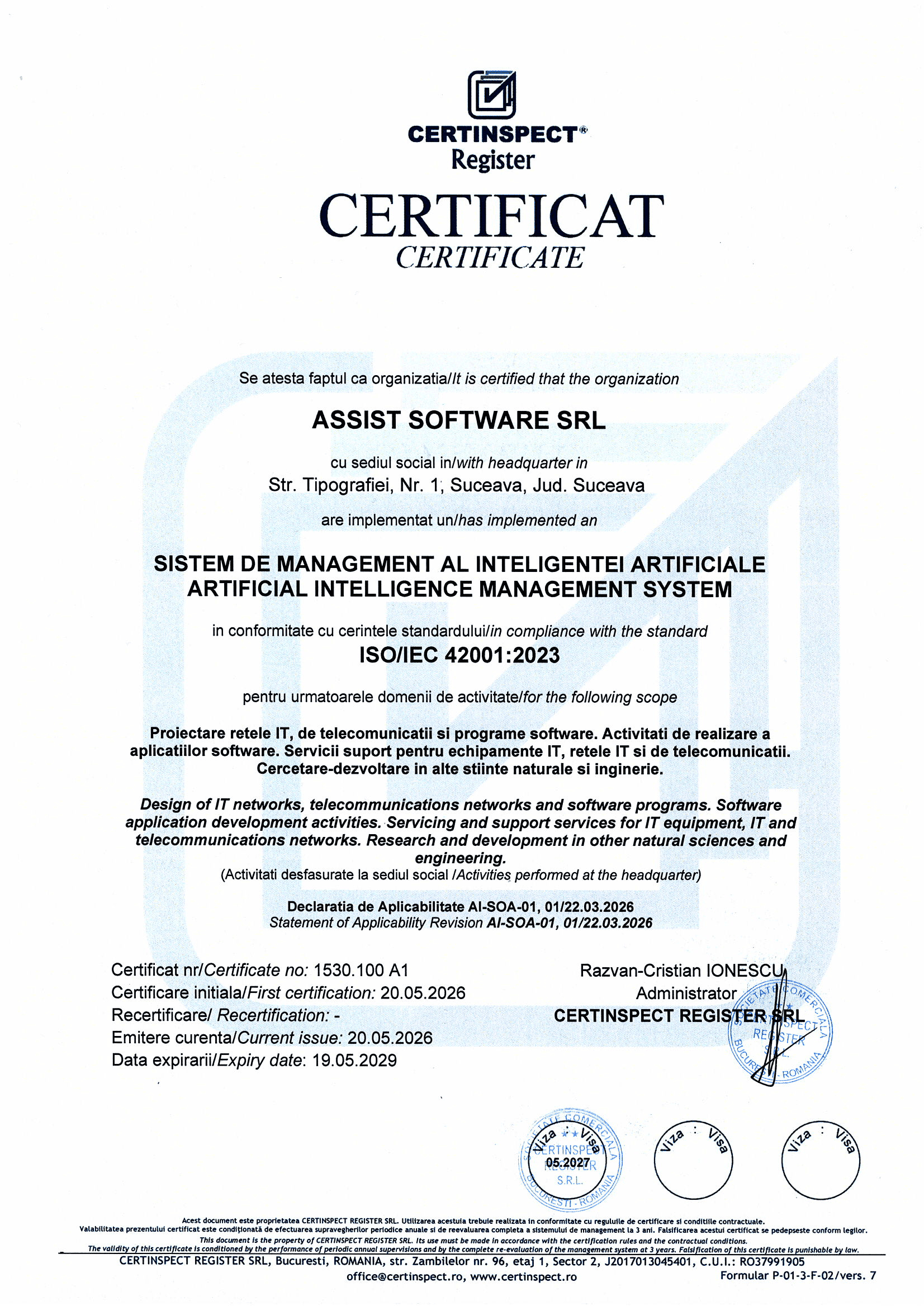
ASSIST Software has earned ISO/IEC 42001:2023 Artificial Intelligence Management Systems certification, becoming one of the first companies in Europe to do so. For a company that has been building AI-based solutions across industries for years, this is less a change in direction and more a formal recognition of how we already approach the work.
Most organizations are deploying AI faster than they are learning to govern it. That gap is where things go wrong quietly, and it is the problem ISO/IEC 42001 was built to address. It is also why we pursued it.
The problem ISO/IEC 42001 was built to solve
ISO/IEC 42001 was developed to address a gap that became increasingly visible as AI moved from research into production. Organizations building or using AI systems needed more than engineering capability. They needed structured processes to manage the specific risks introduced by AI: probabilistic outputs, data dependencies, explainability requirements, fairness considerations, and the challenge of maintaining system performance over time.
The standard defines requirements for establishing, implementing, maintaining, and continually improving an Artificial Intelligence Management System. It applies to organizations that develop, provide, or use AI-based products and services, and it addresses the full lifecycle of an AI system, from planning and development through deployment, monitoring, evaluation, and improvement.
For organizations operating in regulated or high-stakes environments, ISO/IEC 42001 provides a framework that aligns AI governance with broader quality, security, and compliance requirements. It is designed to support responsible innovation, not constrain it.
Why AI governance has become a business requirement
AI is no longer confined to proof-of-concept projects. It is embedded in enterprise platforms, customer-facing applications, data pipelines, cybersecurity systems, healthcare solutions, industrial automation, and decision-support environments across industries.
That shift brings significant opportunities. It also introduces risks that cannot be managed solely through technical performance. AI systems must be designed and operated in ways that support accountability, protect data, enable compliance, and instill confidence in stakeholders who depend on them.
Organizations that treat governance as a separate concern from engineering tend to discover the gap at the worst possible moment: after deployment, when something goes wrong, and there is no clear process for understanding why or who is responsible. ISO/IEC 42001 is designed to close that gap before it opens.
What this certification means for ASSIST Software's clients
For clients working with ASSIST Software on AI initiatives, ISO/IEC 42001 certification provides concrete assurance across several dimensions.
- AI governance: defined processes, roles, and responsibilities for managing AI systems throughout their lifecycle.
- Risk management: a structured approach to identifying, assessing, and mitigating AI-related risks before and after deployment.
- Transparency and accountability: clear visibility into how AI systems are designed, monitored, and improved over time.
- Security and privacy: stronger alignment between AI development practices and broader information security requirements.
- Lifecycle management: continued attention to AI system performance after deployment, including monitoring, retraining, and improvement processes.
- Stakeholder confidence: a recognized international standard that signals maturity to partners, regulators, and decision-makers.
This is particularly relevant for organizations in sectors where AI must be reliable, explainable, and aligned with both internal policies and external regulatory requirements. Healthcare, defense, finance, and industrial automation all demand governance that goes beyond model accuracy.
How this fits into ASSIST Software's broader AI work
ASSIST Software has been building AI-based solutions across multiple domains, combining software engineering, data engineering, machine learning, automation, and system integration. The work spans AI-driven platforms, generative AI solutions, computer vision, natural language processing, MLOps, adaptive interfaces, and AI-enabled decision support.
ISO/IEC 42001 certification builds on that foundation by formalizing the governance layer required for responsible AI development. It complements existing commitments to quality and security, and it aligns with ASSIST Software's involvement in European initiatives, including DataPACT, which focuses on ethical and compliant data and AI pipelines, and SECASSURED, which addresses secure software lifecycle processes and AI-driven security assurance.
The certification is also a direct reflection of a position ASSIST Software has consistently held that AI systems moving from experimentation into production require strong models, strong governance, monitoring, data quality, integration discipline, and long-term maintainability.
Responsible AI is what makes innovation sustainable
The organizations that will get lasting value from AI are the ones that build AI systems that can be trusted, audited, maintained, and improved over time. That requires technical capability and governance working together, not separately.
ISO/IEC 42001 certification is ASSIST Software's formal commitment to that approach. It reflects how AI development is managed inside the company and what clients can expect from every AI initiative built in partnership with ASSIST Software going forward.
Frequently asked questions
What is ISO/IEC 42001 certification, and who is it for?
ISO/IEC 42001 is the world's first international standard for Artificial Intelligence Management Systems. ASSIST Software has achieved this certification, confirming that its AI development and governance processes meet the requirements of a recognized international framework. The standard applies to organizations that develop, provide, or use AI-based products and services, and it covers the full lifecycle of AI systems from planning and development through deployment, monitoring, and continuous improvement.
What does ISO/IEC 42001 certification mean in practice?
It means the certified organization has implemented a structured management framework for AI governance. This includes defined processes for risk management, transparency, accountability, security, data quality, and lifecycle management of AI systems. It provides assurance to clients, partners, and regulators that AI development and deployment are governed according to a recognized international standard.
Why does AI governance matter for enterprise AI adoption?
As AI moves into production environments, the risks associated with poor governance become operational risks. Systems that lack accountability structures, monitoring processes, or clear ownership can fail quietly, produce biased outputs, or create compliance exposure. Governance frameworks like ISO/IEC 42001 address these risks by establishing the policies, responsibilities, and processes required for responsible AI use.
How does ISO/IEC 42001 differ from other technology certifications like ISO 27001?
ISO 27001 addresses information security management. ISO/IEC 42001 addresses the specific challenges introduced by AI systems, including probabilistic outputs, data dependencies, explainability, fairness, and the need for continuous monitoring and retraining. The two standards are complementary, and organizations with strong information security practices are well-positioned to implement AI governance alongside them.