Cloud Computing Explained: IaaS vs Paas vs SaaS vs BaaS
With this article, we hope to outline what cloud computing is, how we use it, and how it can help our clients to leverage its benefits.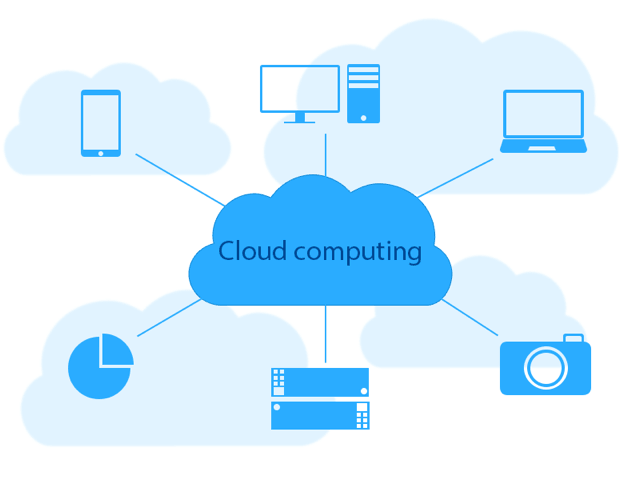
Cloud computing is the delivery of IT resources, such as servers, storage, databases, and software, over the internet on a pay-as-you-go basis. Instead of owning physical infrastructure, companies access scalable computing power on demand.
This model enables organizations to innovate faster, reduce upfront costs, and operate globally without infrastructure limitations.
Cloud providers try to maximize the effectiveness of these shared resources, and prices are adjusted with each improvement.
Cloud Computing Models Overview
Cloud service models can be viewed as layers, where each layer abstracts more responsibility away from the user.
IaaS → maximum control, infrastructure level
PaaS → development-focused environment
SaaS → ready-to-use software
BaaS → backend services out of the box
The key difference lies in who manages what: you or the cloud provider.
Cloud computing solutions are grouped in multiple categories depending how the resources are exposed to final users.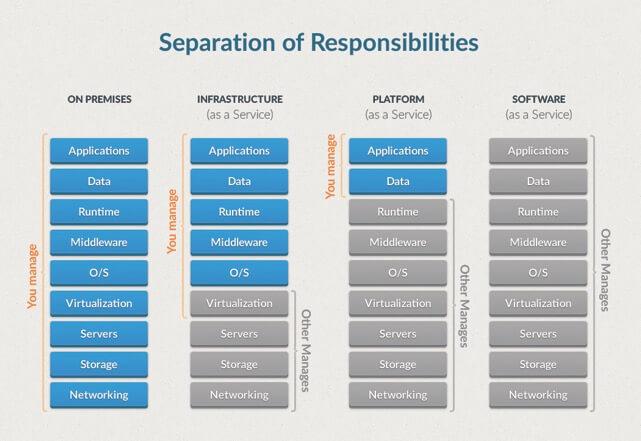
As shown in the image, the main differences between the platform is regarding what resources are managed by the user and which are managed by the cloud provider on each solution.
- On-demand scalability – Instantly scale resources up or down
- Cost efficiency – Pay only for what you use
- Global accessibility – Access systems from anywhere
- Automatic updates – No manual maintenance required
- Enterprise-grade security – Managed by cloud providers
Cloud computing has become the backbone of modern digital transformation strategies.
We’ll describe them in more depth in the next sections.
IaaS provides the basic building blocks of cloud infrastructure, including virtual machines, storage, and networking.
When choosing an Infrastructure as a Service (IaaS) solution, several major cloud providers dominate the global market, each offering distinct advantages.
- AWS (Amazon Web Services) - The market leader in cloud computing, AWS offers the most comprehensive range of services and global infrastructure. It provides a Free Tier for new users, making it a strong choice for startups and scalable enterprise applications.
- Microsoft Azure - A powerful cloud platform with strong integration into the Microsoft ecosystem. Azure is widely adopted by enterprises and supports multiple operating systems, including Linux, making it highly flexible for hybrid environments.
- Google Compute Engine (GCP) - Known for high-performance infrastructure and competitive pricing, Google Cloud is rapidly growing. It excels in data processing, AI, and machine learning workloads, although its global footprint is still expanding compared to AWS and Azure.
With IaaS, companies have full control over:
- Operating systems
- Applications
- Runtime environments
This makes it the most flexible cloud model, but also the most complex to manage.
Typical use cases:
- Enterprise-grade applications
- Custom system architectures
- Migration from on-premise infrastructure
Key benefit: Maximum control and customization.
Choosing between these providers depends on your technical requirements, budget, and ecosystem preferences.
PaaS delivers a complete platform for application development, including tools, frameworks, and infrastructure.
One of the key advantages of Platform as a Service (PaaS) is that it eliminates the need for managing infrastructure and operations. Developers can focus entirely on building and deploying applications, while the cloud provider handles servers, runtime environments, and scaling.
We work with a wide range of PaaS solutions, but commonly recommend platforms such as Heroku, Google App Engine or SalesForce, depending on the specific requirements of the application. Each platform has its own strengths, from rapid deployment and ease of use to enterprise-grade scalability and ecosystem integration.
One of the advantages of Google App Engine is the datastore database, a schema-less NoSQL database. Most notable users of GAE are Snapchat, Khan Academy.
Heroku is very friendly for developers but lacks storage so you will need to rely on third parties like Amazon S3.
SaaS provides fully functional applications that users can access directly through a web browser.
At the moment, many startups are choosing this business model to deliver software solutions to consumers. One advantage for end users is that they do not have to update software; in the cloud, it is always running the latest version.
Everything is managed by the provider, including:
- Infrastructure
- Updates
- Security
Typical use cases:
- Customer relationship management (CRM)
- Collaboration tools
- Business productivity software
Key benefit: Zero infrastructure management and immediate usability.
Is an approach to cloud computing that provides a backend for applications (mostly mobile). They provide an API and tools for different computer languages to integrate with their backend. They also provide additional services like storage, Analytics, Push notifications, dashboards, social integration.
Somehow it is similar to SaaS, but BaaS is mostly targeted at developers, where SaaS is targeted at end users.
Parse is the most known BaaS and it was acquired by Facebook on 2013. Provides integration with most computer languages and covers all services needed by an application. They offer a free tier for small apps.
Another popular BaaS is Firebase, which was recently acquired by Google. It is primarily targeted at real-time apps and also provides storage.
BaaS is highly recommended if the solution needs to be developed quickly with a stable backend. We use Parse for our projects when the application requirements need such a solution.
BaaS is designed to simplify backend development by providing pre-built services such as:
- Authentication
- Database management
- APIs
- Cloud storage
This allows developers to focus on the frontend and user experience instead of backend logic.
Typical use cases:
- Mobile applications
- Startups and MVPs
- Rapid product launches
Key benefit: Accelerated development and reduced backend complexity.
Public cloud is a type of cloud where resources are shared between multiple users and are publicly available to any company/user.
Downside for a public cloud is the risk for virtual machines to break the virtualization sandbox that can lead to security issues.
To mitigate this issue, a client can choose a private cloud where hardware, storage, and network are dedicated to a single client. Also, to achieve PCI compliance, HIPAA is much easier in a private cloud.
Choosing the Right Cloud Model
Selecting the right cloud model depends on your business needs, technical capabilities, and development goals.
Choose IaaS if you need full control and customization
Choose PaaS if you want to accelerate development
Choose SaaS if you need ready-to-use solutions
Choose BaaS if you want to build apps quickly without backend complexity
In practice, many organizations combine multiple models in a hybrid or multi-cloud strategy.
Understanding the differences between IaaS, PaaS, SaaS, and BaaS is essential for making informed technology decisions.
Each model serves a distinct purpose, and choosing the right one can significantly impact development speed, scalability, and operational efficiency.
There is no universal solution, only the right fit for your specific use case.
Frequently asked questions
1. What is the difference between IaaS, PaaS, SaaS, and BaaS?
The difference lies in the level of control and responsibility. IaaS provides infrastructure, PaaS offers a development platform, SaaS delivers ready-to-use software, and BaaS supplies backend services.
2. Which cloud model is best for startups?
Startups typically benefit from SaaS and BaaS, as they allow fast development and minimal infrastructure management.
3. Can you combine multiple cloud service models?
Yes. Many companies use a mix of IaaS, PaaS, and SaaS in a hybrid or multi-cloud architecture.
4. Why is BaaS important for modern applications?
BaaS reduces development time by providing ready-made backend services, allowing teams to focus on user experience and core functionality.
Author
Cristi Spoiala, CTO at ASSIST Software, is a technology leader with over 20 years of experience in software development, systems architecture, and emerging technologies. He specializes in cloud, Kubernetes, IoT, and scalable distributed systems, continuously identifying and integrating the right technologies to deliver high-impact solutions.
Throughout his career, he has led the development of complex, enterprise-grade projects across multiple industries, combining deep technical expertise with a strong focus on business outcomes. His approach balances innovation with reliability, ensuring that solutions are not only cutting-edge but also sustainable in production environments. In recent years, he has also taken on a strategic role in guiding teams, mentoring engineers, and shaping long-term technology direction within ASSIST Software.