Software resilience: why your business is only as strong as its worst engineering decision
Fragile software drains the business quietly
Good architecture is invisible until it isn't
The decisions made in year one show up in year three
AI is only as reliable as the infrastructure it runs on
Resilience is proven when systems must work together under pressure
What long-term software resilience requires in practice
How ASSIST Software builds software that holds up over time
Frequently Asked Questions
Business resilience used to be a conversation about finance, supply chains, and operational planning. It still is, but somewhere along the way, a quieter dependency crept into the picture: the software layer running beneath it all. Most organizations have not fully grasped what that means, and the ones that do tend to discover it after something has already gone wrong.
The systems that run a company, from enterprise software solutions to customer-facing applications, now determine how fast decisions get made, how safely data moves, how well teams can work together, and how quickly the organization can respond when something unexpected happens. A strong strategy and experienced people can only take a company so far if the software they depend on is fragile, outdated, or built in ways that resist change.
Fragile software drains the business quietly
Software problems rarely announce themselves. They show up as friction: a workflow that takes longer than it should, two systems that should exchange data but do not, a platform that worked fine two years ago but now struggles under the load, a security fix that keeps getting pushed back because the codebase is too tangled to touch safely.
Each of these is a small problem on its own. Together, they accumulate into something more serious: slower decisions, higher operational costs, security exposure, and teams spending time on workarounds instead of actual work. The organization loses the ability to move quickly when it needs to. That is the real cost of software fragility, and it is rarely visible until it is already embedded in how the business operates.
A resilient software system is one that continues to support the business as user numbers increase, integrations change, data volumes grow, regulations evolve, and new technologies are adopted. Reaching that level of reliability requires deliberate engineering decisions made early, not patches applied later.
Good architecture is invisible until it isn't
The decisions that determine whether a software system ages well or badly are mostly invisible when things are working. Users see the interface. Leadership sees the outputs. Nobody sees the architectural choices that make a system easy to extend, secure to maintain, and safe to scale.
Those choices matter enormously over time. A well-designed system absorbs change without breaking. Adding a new feature, integrating a new tool, onboarding more users, or responding to a new regulatory requirement becomes a manageable task rather than a risky one. A poorly designed system turns every one of those moments into a potential crisis, because each change touches something that was never meant to be touched.
Engineering discipline is not the glamorous part of software development. It is the part that determines whether the investment holds up over three years or starts creating problems after six months. The organizations that understand this tend to build software that becomes a durable asset. The ones that do not tend to rebuild the same systems repeatedly.
The decisions made in year one show up in year three
The connection between software architecture and business performance is rarely direct enough to appear in a quarterly report, but it shapes operational reality in ways hard to ignore. Teams working with well-structured systems spend their time on the work that matters. Teams working around fragile infrastructure spend their time managing limitations.
This matters especially during periods of growth or change. When a company scales, expands into new markets, undergoes a merger, or needs to comply with new regulations, the software layer either supports that transition or becomes the main obstacle to it. Organizations that have invested in maintainable, modular architectures tend to move through those moments without losing operational continuity. The ones that have not tend to discover the cost of that decision at exactly the moment they can least afford it.
AI is only as reliable as the infrastructure it runs on
Many organizations are moving quickly into AI right now, and many are discovering that the results depend less on the model they choose and more on the infrastructure around it. AI needs clean data pipelines, reliable integrations, clear access controls, monitoring, and governance. Without those things in place, models that perform well in a controlled environment often fail to deliver value when connected to the business's real systems.
The organizations that consistently achieve returns from AI are not necessarily the ones with the most sophisticated models. They are the ones whose software layer was ready to support production use. Data that is inconsistent across sources, systems that do not communicate reliably, and processes that vary in ways the model was not trained for are all infrastructure problems that tend to surface after deployment rather than before.
For organizations serious about AI adoption, investment in software resilience is not a separate workstream. It is a prerequisite.
Resilience is proven when systems must work together under pressure
Every API, user role, database, and integration point is part of a business's security surface. As organizations become more connected, that surface grows. Security practices that sit outside the development process and are applied at the end as a checkpoint tend not to hold up over time. The ones that work are built into architecture, deployment workflows, and ongoing monitoring from the beginning.
This matters especially in sectors where data sensitivity, regulatory compliance, and operational continuity are non-negotiable: healthcare, finance, manufacturing, defense, and enterprise platforms supporting critical operations. In those environments, security is not an add-on to a system. It is a structural property of the system's design.
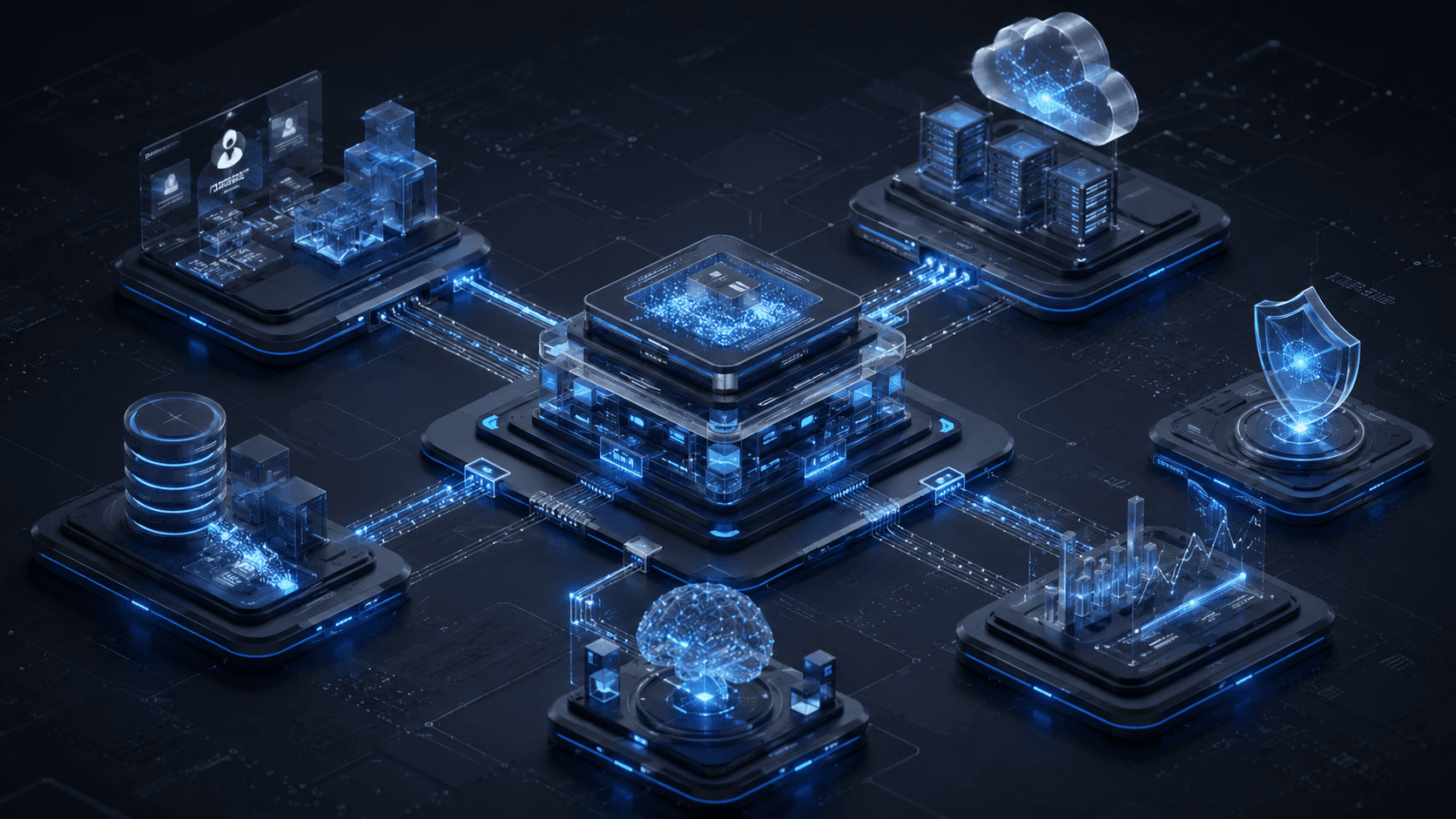
Integration is where the practical resilience of a software ecosystem becomes visible. Most companies operate a combination of older systems, modern platforms, cloud tools, and third-party services that were never designed to work together. When that integration is solid, data flows, automation works, and teams have the visibility they need to make good decisions. When it is not, the gaps show up across every part of the business, often in ways that are difficult to trace back to their source.

What long-term software resilience requires in practice
Building software that remains reliable and useful over time requires four things that are frequently underestimated in project planning. Architecture designed for change, meaning systems built with modularity and maintainability in mind from the start. Security is integrated into development and deployment workflows rather than applied as a final checkpoint. Integration governance, meaning a defined approach to how systems communicate and how upstream changes are assessed for downstream impact. Ongoing observability, meaning the monitoring needed to detect when a system's behavior is drifting from what the business depends on.
None of these is technically complex in isolation. Together, they represent an engineering culture that treats software as a long-term operational commitment rather than a series of deliverables.
How ASSIST Software builds software that holds up over time
At ASSIST Software, we build enterprise software solutions knowing that every system we deliver will eventually become part of a larger operational environment. It will need to work with real users, connect to other systems, handle data it was not originally designed for, and keep performing as the business around it changes. That reality shapes how we think about architecture, security, AI integration, cloud infrastructure, and data engineering across every project we take on.
The industries we work in, including healthcare, defense, industrial automation, and enterprise platforms, share a common requirement: software that holds up under real conditions, remains secure over time, and can be maintained without introducing new risks. That is the standard we apply, and it is the standard that business resilience increasingly demands.
The organizations that get the most from their software over time are the ones that treat it as a long-term asset. Building something that works today is the starting point. Building something that continues to work as the business grows, changes direction, and adopts new technologies is the actual goal.
Frequently Asked Questions
What is software resilience, and why does it matter for business continuity?
Software resilience refers to a software system's ability to continue functioning reliably as conditions around it change, including increases in user load, changes in data, new integrations, evolving security requirements, and shifts in business processes. It matters for business continuity because modern organizations depend on software for the coordination, communication, and decision-making that keep operations running. A fragile software layer creates operational risk that compounds over time, often in ways that are not visible until the business is already affected.
How does software architecture affect long-term business performance?
Software architecture determines how easily a system can be extended, secured, integrated with other tools, and maintained as requirements change. Well-designed architecture allows organizations to adapt quickly without accumulating technical debt or creating operational risk with every change. Poorly designed architecture turns routine updates into significant engineering challenges and can become the primary obstacle to growth, compliance, or technology adoption during critical business transitions.
What role does software infrastructure play in successful AI adoption?
AI systems depend on the software infrastructure around them to deliver value in production. Clean data pipelines, reliable integrations, access controls, monitoring, and governance are all infrastructure requirements that determine whether an AI model performs as expected in a real business environment. Organizations that attempt AI adoption without first addressing software resilience often find that models that perform well in testing fail to create value once connected to production systems.