Data governance for enterprise AI: why the quality of your data determines the quality of your results
Why data quality determines what AI can do
What data governance covers in an enterprise AI context
Why data integration and lineage are where governance gets real
Why access governance is a non-negotiable requirement
Why data observability is what keeps governance working after deployment
How to approach data governance for AI without rebuilding everything at once
How ASSIST Software approaches data governance in enterprise AI projects
The quality of an AI system is determined before the model ever runs
Frequently asked questions
Most AI initiatives eventually run into the same problem, and it has nothing to do with the model. Incomplete records, conflicting information across systems, outdated content treated as current, and unclear ownership of who is responsible for what are the conditions under which even capable AI systems produce results that are inaccurate, difficult to explain, or unsuitable for business decisions.
Data governance is what organizations put in place to prevent that. In the context of enterprise AI, it has moved from a compliance exercise to a core engineering requirement, and the organizations that treat it as such consistently build AI solutions that hold up in production rather than stalling after a promising proof of concept.
This article covers what AI data governance entails, why it matters at each stage of the AI lifecycle, and what organizations need to address before they can rely on AI-driven decisions in real-world business operations.
Why data quality determines what AI can do
An AI system works with the information available to it. When that information is fragmented or inconsistent, the model cannot compensate. It processes what it receives and returns a result that reflects the quality of its inputs, not some corrected or idealized version of the underlying reality.
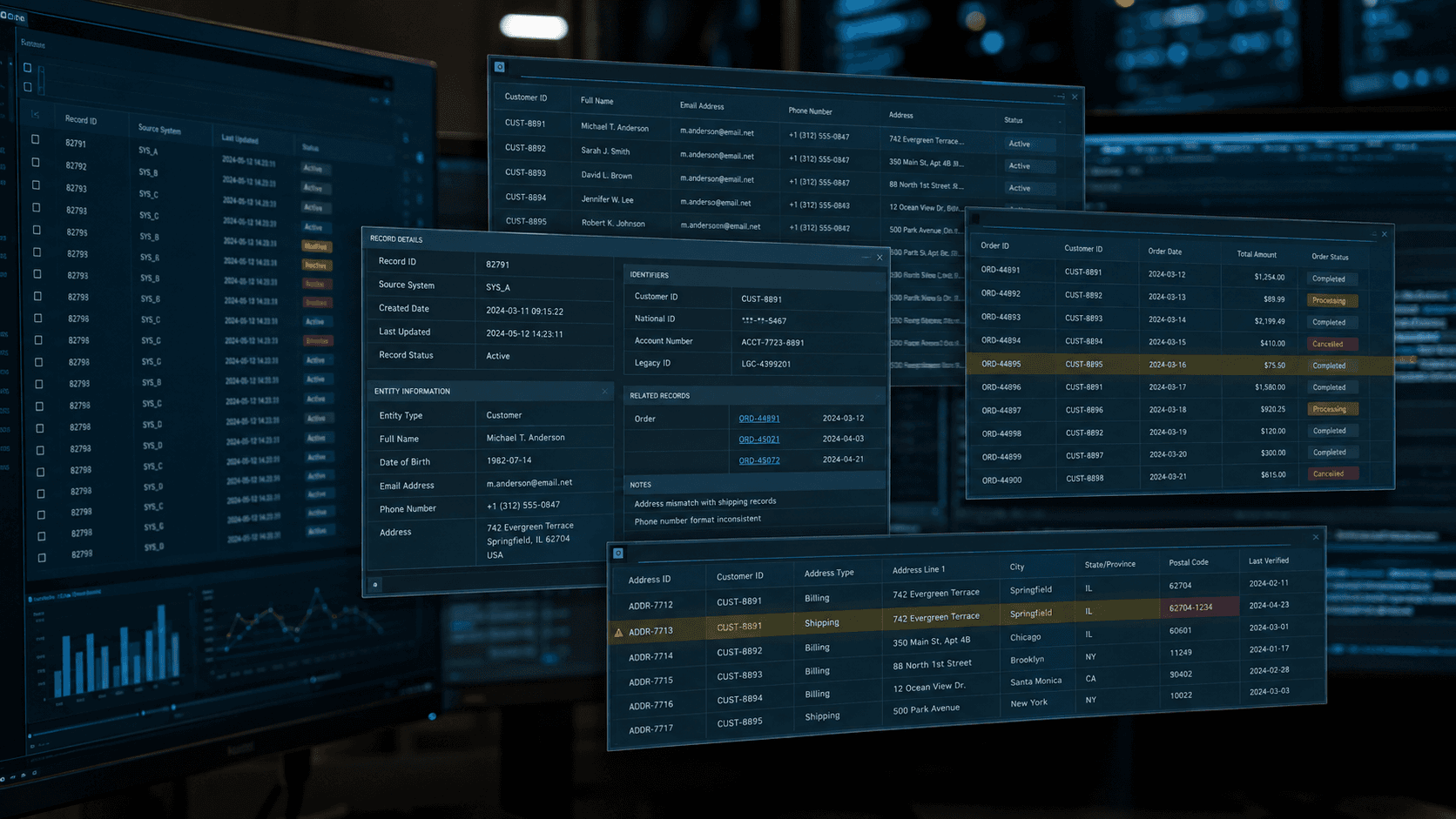
Enterprise data needs to be complete, consistent across systems, current, valid according to business rules, and accessible when required. These requirements sound straightforward, but they are rarely met without deliberate governance. A customer service AI connected to multiple internal platforms might find the current customer address in one system, an older version in another, and a different customer identifier in a third. The model has no independent way to determine which record is authoritative. Data governance provides the rules and validation processes that resolve those inconsistencies before they affect the output.
The consequences of poor data quality in AI systems are rarely dramatic. They are gradual: a recommendation becomes slightly less relevant, a classification starts missing cases it should catch, and a prediction drifts from what the business depends on. Each issue, in isolation, is easy to dismiss, but collectively they erode trust in the system until the AI is no longer used to support the decisions it was built to make.
What data governance covers in an enterprise AI context
Data governance is often understood narrowly as a set of policies about who can access what data. In practice, it is a broader framework that establishes ownership, quality standards, classification rules, retention requirements, access controls, and processes for maintaining them as the data environment evolves.
For AI specifically, governance needs to address several dimensions that traditional data management did not prioritize. It needs to define which data sources are authoritative for a given domain, how conflicting records are resolved, how data is prepared and validated before it reaches the model, which users and systems are permitted to access which information through an AI interface, and how the AI's use of data is monitored and audited over time.
These are not one-time decisions. They require ongoing attention as data sources change, as new systems are integrated, and as the AI application is extended to cover new use cases or user groups.
Why data integration and lineage are where governance gets real
Enterprise information rarely lives in one place. It is distributed across CRM and ERP platforms, document repositories, data warehouses, cloud services, operational databases, and custom applications built over years or decades. Connecting those sources so that AI can access the relevant information is a significant engineering effort and doing it poorly can reproduce existing inconsistencies at a larger scale rather than resolving them.
A governed integration architecture ensures that information reaches the AI system in a controlled and understandable form, preserving data definitions, access permissions, relationships between records, and quality controls across every connection. Without that architecture, the AI may receive information that is technically available but contextually unreliable.
Data lineage adds another critical layer. It documents where information originated, how it was transformed, which systems processed it, and where it is currently in use. For AI solutions, this becomes essential when teams need to investigate an incorrect output, respond to a compliance inquiry, or understand why a model's behavior has changed. Without a clear lineage, it is often impossible to determine whether a problem came from the original source, a transformation rule, an outdated integration, or the model itself. Clear lineage makes that investigation faster, provides the foundation for accountability, and enables regulators or auditors to demonstrate exactly how data was used in a given decision.
Why access governance is a non-negotiable requirement
Enterprise AI needs context to be useful, but giving a system unrestricted access to organizational data creates risk that outweighs the operational benefit. A well-designed data governance framework ensures that AI systems retrieve only the information required for a specific task, enforcing the same role-based permissions and confidentiality rules that apply across other enterprise applications.
This matters especially when AI applications work with personal or financial information, internal company documents, healthcare or regulated data, client records, or sensitive operational systems. A user should not be able to retrieve information through an AI interface that they would not be authorized to access through standard application channels. Access controls, audit trails, and data boundaries need to be part of the governance architecture from the beginning, not added as a compliance measure after the system is already in use.
In regulated industries, this is not optional. Healthcare, finance, defense, and critical infrastructure all operate under frameworks that impose specific requirements on how data is accessed, processed, stored, and audited. AI systems operating in these environments need to meet those requirements as completely as any other enterprise application.
Why data observability is what keeps governance working after deployment
Data environments change constantly. Integrations fail, source formats are modified, records become outdated, and unexpected values enter production systems. A data set that was reliable during development may deteriorate after deployment, and without visibility into those changes, teams discover the problem only after it has already affected users or business operations.
Data observability monitors the health of data pipelines and surfaces issues before they compound: freshness, volume, schema changes, distribution anomalies, failed pipelines, and unexpected quality drops. For AI applications in particular, observability can identify when changes in data begin to affect system performance, allowing teams to investigate and intervene before the degradation reaches a level that affects the business.
This is what turns data governance from a one-time setup into an ongoing operational discipline. The organizations that treat it this way consistently maintain higher AI system reliability over time than those that establish governance at deployment and revisit it only when something breaks.
How to approach data governance for AI without rebuilding everything at once
Organizations do not need to govern every data set before building useful AI solutions. A more practical approach is to begin with a specific use case, identify the information required to support it, and build the governance model around those sources before expanding.
This means identifying the relevant data sources and their current quality levels, assigning ownership and accountability for each, defining quality requirements specific to the AI use case, documenting data flows and transformations, establishing access permissions consistent with existing organizational rules, and putting monitoring in place before the system goes live rather than after the first incident.
Starting with a bounded scope allows the team to validate the governance approach, surface data quality issues early, and demonstrate that the AI solution produces reliable results before committing to a broader rollout.

How ASSIST Software approaches data governance in enterprise AI projects
At ASSIST Software, data governance is not something addressed after the AI components are in place. It is part of how AI implementation is approached from the beginning, alongside architecture, integration, security, and operational requirements.
The organizations we work with across healthcare, industrial automation, defense, and enterprise software typically have data distributed across multiple systems, some modern and some not, with varying levels of documentation, access control maturity, and quality consistency. Building AI solutions that work reliably in those environments means applying the same engineering discipline to the data infrastructure as to the AI components themselves.
ASSIST Software holds ISO 42001:2023 certification for Artificial Intelligence Management Systems, making it one of the first companies in Europe to achieve this standard. That governance framework shapes how we approach data quality, lineage, access control, and observability across every AI initiative we take on, from initial architecture through deployment and ongoing operation.
The quality of an AI system is determined before the model ever runs
The quality of an enterprise AI solution is determined before the model ever runs. It is determined by whether the system receives reliable information, understands where that information came from, respects access rules, and remains observable after deployment. Organizations that treat data governance as a prerequisite rather than an afterthought are the ones building AI solutions that hold up in production, not just in demonstrations.
Frequently asked questions
- What is data governance for AI, and why does it matter?
Data governance for AI refers to the framework of policies, processes, ownership rules, quality standards, access controls, and monitoring mechanisms that ensure the data used by AI systems is accurate, consistent, secure, and fit for its intended purpose. It matters because AI systems derive their behavior from the information they receive, and when that information is incomplete, inconsistent, or poorly governed, even capable models can produce unreliable or unsuitable results for business decisions. Data governance is what makes the difference between AI that performs well in testing and AI that remains reliable in production.
- What is data lineage, and why is it important for AI systems?
Data lineage is the documentation of how data moves through an organization: where it originated, how it was transformed, which systems processed it, and where it is currently in use. For AI systems, lineage is critical for investigating incorrect outputs, responding to compliance inquiries, and understanding why a model's behavior has changed over time. Without a clear lineage, it is often impossible to determine whether a problem originated in the source data, a transformation rule, an integration failure, or the model itself, making both troubleshooting and accountability significantly more difficult.
- What is data observability, and how does it support enterprise AI?
Data observability is the continuous monitoring of data pipelines and data quality to detect issues before they affect downstream systems or business operations. It tracks factors such as data freshness, volume, schema changes, distribution anomalies, and pipeline failures. For AI applications, data observability is particularly important because changes in the data environment can gradually degrade model performance in ways that are not immediately visible. Teams that monitor data observability can identify and address these issues early, maintaining AI system reliability over time rather than discovering problems after they have already affected users or business decisions.