Enterprise AI integration: why the model is only one part of the solution
Why isolated AI tools have limited value in enterprise environments
What production-ready AI integration requires
Why data access governance is a non-negotiable requirement
The legacy system challenge that most organizations underestimate
Why human oversight needs to be designed in, not added later
How ASSIST Software approaches enterprise AI integration
Integration is what turns AI capability into business value
Frequently Asked Questions
Most AI initiatives begin with the same question: which model should we use? It is a reasonable starting point, but it rarely determines whether the project succeeds. In an enterprise environment, the model is only one component. The harder work begins when AI needs to access the right information, interact with existing business systems, follow internal rules, and produce an output that someone or something can act on reliably and at scale.
This article covers what enterprise AI integration involves, where the most common failure points are, and what organizations need to get right before a production deployment can be considered successful.
Why isolated AI tools have limited value in enterprise environments
A standalone AI tool can summarize a document, generate content, or answer a question. That can be useful in isolation. It does not necessarily improve the broader business process or create the operational leverage most organizations seek when they invest in AI.
For AI to deliver lasting value in an enterprise context, it needs to work with the systems the organization already relies on: CRM and ERP platforms, internal databases, document management systems, cloud infrastructure, communication tools, analytics platforms, and custom or legacy applications. Without those connections, employees still copy information between systems, manually verify outputs, and complete the next steps themselves. The result is a helpful feature sitting alongside existing workflows rather than an integrated solution embedded within them.
The distinction matters because enterprise AI adoption is rarely justified by individual productivity gains. It is justified by process-level improvements that scale across teams, departments, and operational contexts. That kind of impact requires integration, and integration requires significantly more engineering than most organizations anticipate at the start of a project.
What production-ready AI integration requires
A production-ready AI integration is significantly more complex than connecting a model through an API. It needs to manage where information comes from, which data the AI is permitted to access, how that information is prepared and validated before the model sees it, what actions the system can take based on the output, when human approval is required before an action is executed, and how outputs are recorded, monitored, and audited over time.
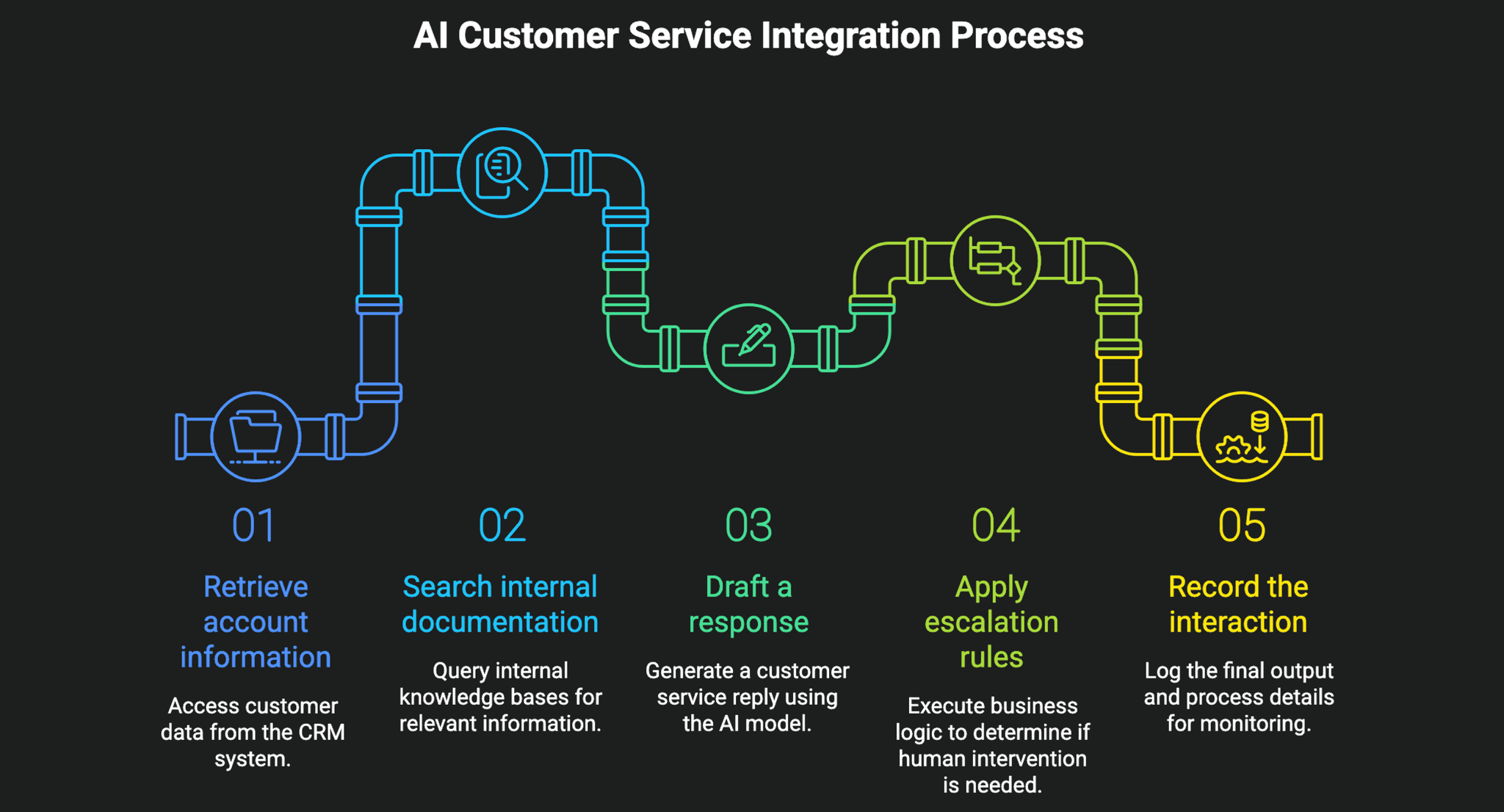
Consider an AI application supporting customer service operations. It may need to retrieve account information from a CRM, search internal documentation, draft a response, apply escalation rules based on customer tier or issue type, and record the interaction for compliance purposes. Each of those steps depends on a different system, permission model, and business rule. The quality of the final solution depends as much on those connections as it does on the model's ability to generate a coherent response.
In enterprise environments, this complexity is compounded by the fact that the systems involved were not designed to work together as AI integration requires. Data formats vary across platforms. APIs are inconsistent or poorly documented. Access permissions are managed differently across systems. And the business rules that govern how information should flow are often undocumented, known only to the people who have been doing the work manually for years.
Why data access governance is a non-negotiable requirement
Enterprise AI needs context to be useful, but giving a system unrestricted access to organizational data is neither necessary nor acceptable from a governance perspective. A well-designed integration retrieves only the information required for the specific task and enforces existing permissions, confidentiality requirements, and data retention rules at the AI layer as consistently as at the application layer.
This becomes critical when AI applications work with personal or financial information, internal company documents, healthcare or regulated data, client records, or sensitive operational systems. A user should not be able to retrieve information via an AI interface that they are not authorized to access through standard application channels. Access controls, role-based permissions, audit trails, and data boundaries need to be part of the integration architecture from the beginning, not added as a compliance afterthought after the system is already in use.
In regulated industries, this is not optional. Healthcare, finance, defense, and critical infrastructure all operate under frameworks that impose specific requirements on how data is accessed, processed, stored, and audited. AI systems operating in these environments need to meet those requirements as completely as any other enterprise application.
The legacy system challenge that most organizations underestimate
Most enterprises are not building on a clean, modern technology stack. AI solutions frequently need to work alongside legacy applications, custom databases developed over decades, manual workflows that exist because no system ever replaced them, and third-party platforms that offer limited integration options.
Replacing those systems is not always practical, and it is rarely necessary to do so to integrate AI effectively. A well-designed integration uses APIs, middleware, event-based architecture, data services, or custom connectors to make selected information and actions available to AI components without disrupting the underlying business processes those systems support.
The objective is not to modernize every system as a prerequisite for AI adoption. It is to create a reliable and maintainable integration layer between AI capabilities and the technology already supporting the organization. That layer needs to be designed with the same engineering discipline applied to any production system: documented, testable, monitored, and built to accommodate change as both the AI components and the underlying systems evolve over time.
Why human oversight needs to be designed in, not added later
Not every AI output should trigger an automatic action. Some tasks are genuinely low risk and can be automated with clear, stable rules. Others require human review because they involve financial commitments, legal obligations, customer-facing decisions, safety considerations, or incomplete or ambiguous information.
A practical AI integration defines which actions can proceed automatically, which outputs require confirmation before execution, who is responsible for approving different categories of decisions, how exceptions and edge cases are handled, and how the process returns control to a human operator when the system encounters a situation outside its defined scope.
Human oversight works best when it is a structural feature of the workflow rather than an informal check that exists alongside an otherwise automated process. The goal is not to slow down automation by placing a person behind every step. It is to involve human judgment at the points where context, accountability, and organizational responsibility genuinely require it.

How ASSIST Software approaches enterprise AI integration
At ASSIST Software, AI integration projects begin with the systems and processes already in place rather than with the AI components. The team assesses the use case, data sources, software architecture, security requirements, user roles, regulatory context, and existing delivery environment before selecting the appropriate AI components and integration approach.
Depending on the project and industry context, the work may involve integrating AI models with CRM, ERP, or document management platforms; connecting internal data sources and knowledge bases through retrieval-augmented generation frameworks; developing custom APIs and middleware to bridge legacy and modern systems; embedding AI features into existing business applications without disrupting established workflows; and implementing monitoring, validation, and human approval workflows that meet both operational and compliance requirements.
ASSIST Software holds ISO 42001:2023 certification for Artificial Intelligence Management Systems, making it one of the first companies in Europe to achieve this certification. That governance framework supports a structured approach to AI risk management, accountability, transparency, and continuous improvement across the full lifecycle of an AI solution, from initial integration through ongoing operation and maintenance.

Integration is what turns AI capability into business value
The model generates the output. Integration determines whether that output reaches the right person, updates the right system, follows the correct rules, respects the appropriate permissions, and produces a result that someone can act on with confidence. Organizations that treat integration, data governance, legacy system compatibility, and human oversight as core engineering requirements from the start are consistently better positioned to move from AI experimentation to reliable operational use. The gap between a successful proof of concept and a production system that creates lasting value is almost always an integration problem, not a model problem.
Frequently Asked Questions
What is enterprise AI integration and why is it different from standard AI deployment?
Enterprise AI integration is the process of connecting AI capabilities to the systems, data sources, workflows, and governance frameworks an organization already relies on. It differs from standard AI deployment in that enterprise environments involve multiple interconnected systems with varying data formats, access controls, and business rules, often including legacy applications not originally designed for AI integration. A model that performs well in isolation may deliver limited value without the infrastructure required to connect it reliably to the rest of the organization.
What are the most common reasons enterprise AI integration projects fail?
The most frequent failure points are not related to model performance. They include incomplete or inconsistent source data, unclear ownership of connected systems, missing or unstable APIs, access permissions that are too broad or too restrictive, no fallback when a model or integration service fails, outputs that cannot be traced back to their source, and poor alignment between the AI system and the actual user workflow. These issues are significantly easier to address during the design phase than after the system has been deployed.
How should organizations approach data access governance for AI systems?
Organizations should apply the principle of least privilege to AI systems: the system should access only the data required for the specific task, enforcing the same role-based permissions and confidentiality rules that apply across other enterprise applications. Access controls, audit trails, and data boundaries need to be part of the integration architecture from the beginning. In regulated industries, AI data governance must also satisfy the specific requirements of applicable frameworks, such as GDPR, sector-specific compliance standards, or data sovereignty requirements.