Robotics internship 2026: how eight students built two autonomous systems in four weeks at ASSIST Software
Most internships end with a presentation. This one ended with a robotic arm picking up an object, placing it on an autonomous ground vehicle, and watching the vehicle navigate to its destination without anyone touching a controller.
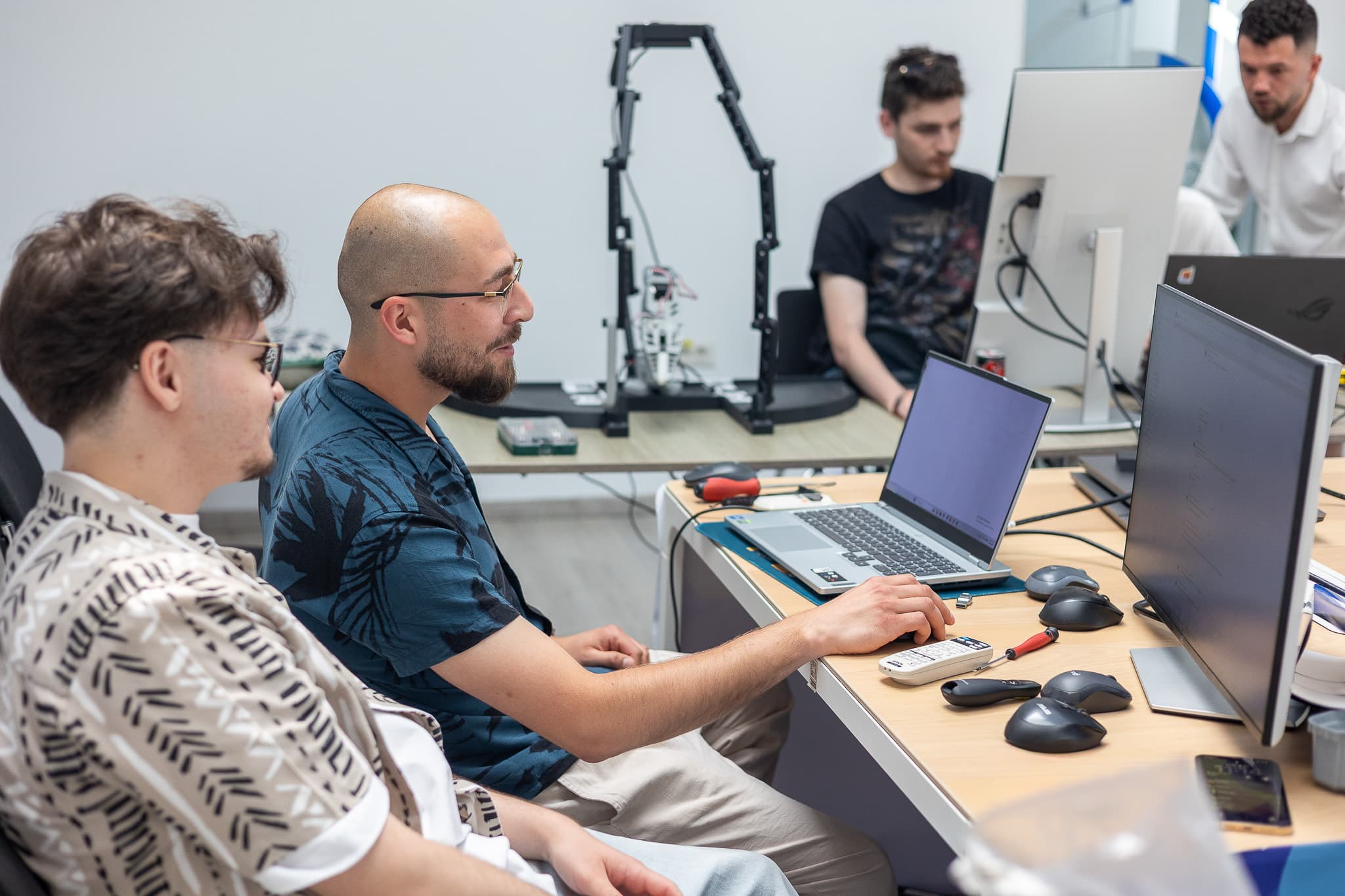
Between May 26 and June 26, 2026, eight students from two faculties spent four weeks in the ASSIST Software R&D lab building a collaborative robotic system from the ground up. Four came from the Faculty of Electrical Engineering and Computer Science in Suceava. Four came from the Faculty of Mechanical Engineering, Automotive, and Robotics. The mix was deliberate: the project required software, hardware, mechanical design, AI, and simulation expertise working together toward a single shared goal.
This article covers what they built, how they built it, and what the experience reflects about how practical engineering education works when it is designed around real problems rather than simplified ones.
Two robots, one shared objective
The internship was structured as a complete engineering project, moving students through design, construction, calibration, simulation, AI training, and final validation. These are the same stages a real product development cycle involves, and the students were expected to work through all of them.
The two systems they built were designed to function together. A robotic arm capable of detecting, picking, and sorting objects. An autonomous ground vehicle able to navigate, avoid obstacles, and transport objects without human assistance. The final demonstration connected both systems into a single collaborative workflow: the UGV navigates to the arm station, the arm detects and picks up an object, places it on the vehicle platform, and the UGV autonomously transports it to a defined destination.
Reaching that collaborative workflow was the core objective of the internship. It required every component, on both systems, to work reliably and in coordination. There was no simplified version of the goal, and no component could be left unfinished without affecting the whole.
What the robotic arm team built
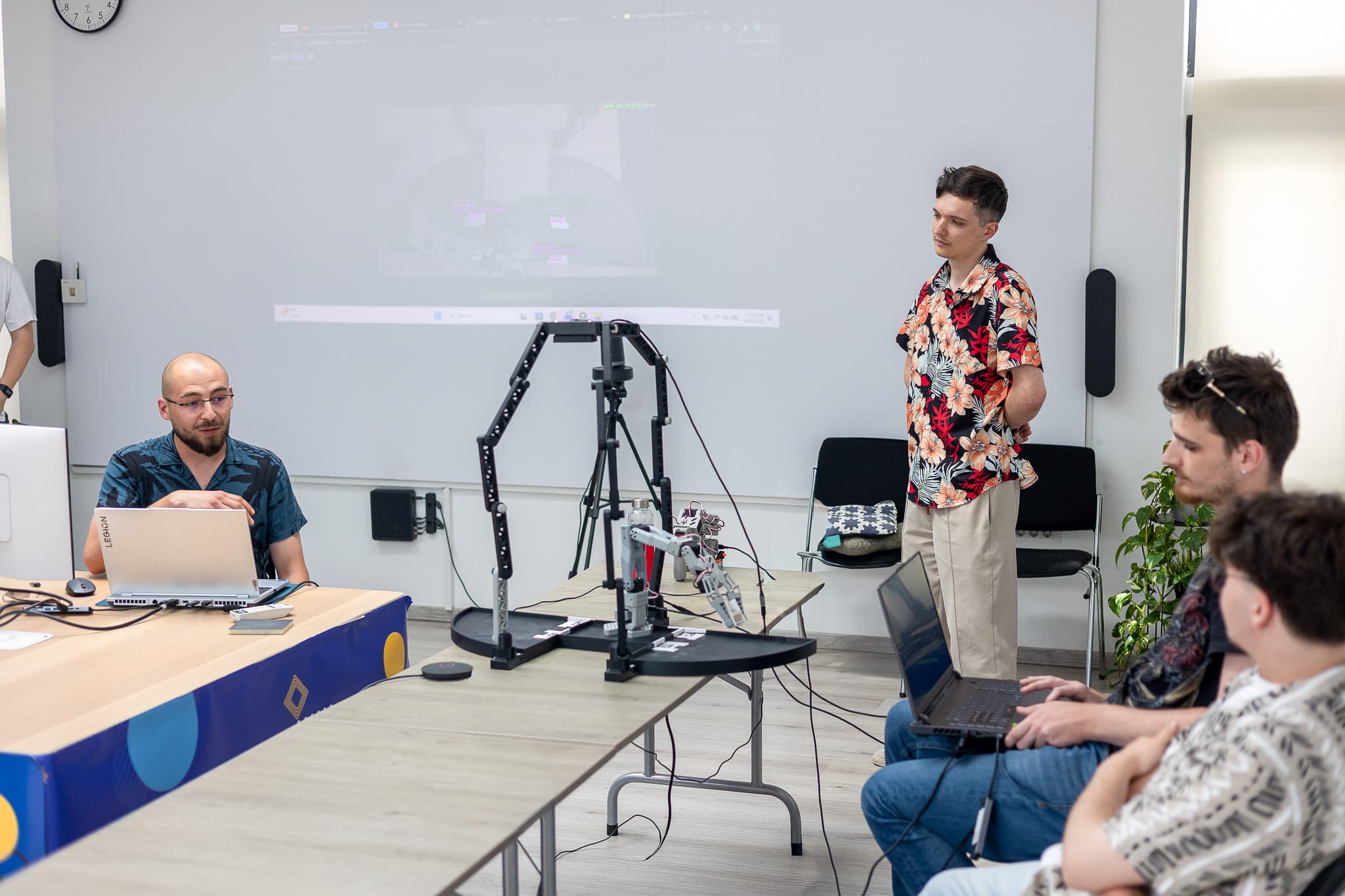
The team responsible for the robotic arm built the SO-101 from 3D-printed structural components, assembled and calibrated the servo motors, and developed a master-slave setup in which a control arm mirrors the robotic arm's movements in real time. That setup became the foundation for imitation learning: demonstrated motions are recorded and used as training data for autonomous behavior, allowing the arm to learn from human demonstration rather than requiring hand-coded instructions for every task.
The team redesigned the gripper during the internship, creating a new two-finger end-effector with improved geometry and updated servo mounting points. The new component was printed, assembled, and reflected in the digital twin in Isaac Sim, so that the simulation matched the physical hardware accurately enough to be useful for training.
A YOLOv8-based computer vision model was trained on real-world data captured through the arm's onboard camera. The model was trained to recognize object classes by color and reached 0.990 mAP@0.5, with precision and recall both exceeding 0.98 at operational confidence thresholds. Before the arm can pick an object, it must reliably detect and locate it. That performance level confirms it can do so under real operating conditions.
The team also developed a custom control interface for calibration, telemetry, program recording and playback, and dual camera views, and built reinforcement learning environments in Isaac Lab for reach, lift, and place tasks. The sim-to-real pipeline they developed allows trained policies to be deployed to the physical SO-101 arm with minimal architectural changes.
What the UGV team built
The UGV team took a Raspbot platform and rebuilt it almost entirely. They designed and 3D-printed a new chassis, battery holder, modular shell, magnetic panels, and a motorized camera system. The new structure improved component layout, cable management, and maintenance access while increasing overall rigidity.
On the software side, the team replaced the standard control layer with a custom library built from scratch, encompassing motor control, servo management, camera operation, sensor integration, and navigation. They also developed a web-based command center with live camera stream, virtual joystick, diagnostics, sensor readouts, autonomous navigation controls, and system logs. FastAPI and WebSockets were used to reduce latency and allow immediate control updates.
By the second week of the internship, the UGV had validated both live obstacle detection and point-to-point autonomous navigation without LIDAR. By the final week, it was operating in a real environment with physical obstacles, navigating independently to defined destinations. The progression from manual control to fully autonomous operation over four weeks reflects both the pace of the work and the complexity of what the team was managing simultaneously.
What the students learned that does not appear on a CV
The technologies the students worked with, ROS, Isaac Sim, Isaac Lab, YOLOv8, FastAPI, WebSockets, reinforcement learning, digital twins, and computer vision, are the same ones shaping how robotics and autonomous systems are being built professionally. The internship did not introduce them to these tools from a distance. It put them to work in real conditions, with real consequences when something did not function correctly.
Beyond the technical skills, the internship surfaced lessons that are harder to capture formally. Simulations need careful tuning before behaviors can be transferred to physical hardware. A new gripper geometry must be reflected in the digital model, or the arm will miss. Latency in a control interface is not just a performance issue but a safety concern. A new chassis changes sensor positioning, affecting the entire perception pipeline.
Most significantly, the students experienced what it means for software and hardware teams to work toward a shared goal where neither side can succeed independently. The decisions made on one system directly affect what is possible on the other, and understanding that dependency in practice is different from understanding it in theory.
Why ASSIST Software structured the internship this way
ASSIST Software's AI Center and Robotics Hub exist because the domains the company works in require people who have built real things under real constraints. Software engineering, AI, simulation, and embedded systems are not fields in which theoretical knowledge alone translates into professional capability. The gap between understanding a concept and reliably deploying it in a physical system is significant, and narrowing it requires direct experience.
The internship was designed around that premise. Mixed teams from different academic backgrounds, a concrete engineering objective, four weeks, and no simplified version of the goal. The result was two functional robotic systems and a collaborative demonstration that worked. For a first run of this format, that is a meaningful outcome.
For the students involved, it was the kind of experience that changes how engineering problems look outside a classroom. For ASSIST Software, it is part of how the company develops its people and capabilities, which its work increasingly demands. Robotics, autonomous systems, and AI-driven hardware are not peripheral areas. They are where the company is investing, and the internship is part of the foundation being built there.
What this reflects about practical engineering education
The ASSIST Software Robotics Internship 2026 is an example of what practical education looks like when it is designed around real engineering problems rather than simplified exercises. The students worked with professional-grade tools, navigated real hardware constraints, and built systems that were evaluated against a concrete operational objective.
That approach produces a different kind of learning than a structured course. It also produces a different kind of engineer: one who has experienced the full complexity of a development cycle, including the parts that go wrong and require rethinking, and who understands that reliable systems are built through iteration, not first attempts.
Frequently asked questions
- What is the ASSIST Software Robotics Internship?
The ASSIST Software Robotics Internship is a practical engineering program run through the ASSIST Software R&D lab, bringing together students from different academic backgrounds to build real robotic systems under professional conditions. The 2026 edition ran for four weeks and resulted in two functional autonomous systems, a robotic arm and an autonomous ground vehicle, designed to work together in a collaborative workflow. The internship is part of ASSIST Software's investment in applied research and practical engineering education through its AI Center and Robotics Hub.
- What technologies did the students use during the internship?
The students worked with ROS, Isaac Sim, Isaac Lab, YOLOv8, FastAPI, WebSockets, reinforcement learning, digital twins, computer vision, and custom hardware, including 3D-printed components, servo motors, Raspberry Pi, and sensor arrays. The robotic arm team developed a sim-to-real pipeline for deploying trained AI behaviors to physical hardware. The UGV team built a custom software control library and a web-based command center from scratch.
- What is a digital twin and how was it used in this project?
A digital twin is a virtual model of a physical system that closely mirrors its real-world counterpart for simulation, testing, and AI training. In this project, the robotic arm team built a digital twin of the SO-101 arm in Isaac Sim, including calibrated joint limits and home positions. When the physical gripper was redesigned, the digital model was updated to match, allowing the team to continue training behaviors in simulation before deploying them to the physical arm through a sim-to-real pipeline.