Cristian Ceamatu Named ASSIST AI Champion for Boosting Team Efficiency
Who Is Cristian Ceamatu?
How Spec-Driven Development Changes the Way Engineers Work with AI
How Spec-Driven Development Extends Impact Beyond Front End
Sharing AI and Spec-Driven Development Across Teams
What This Recognition Represents
Key Insights: Scaling Spec-Driven Development Through Individual Expertise
Frequently Asked Questions
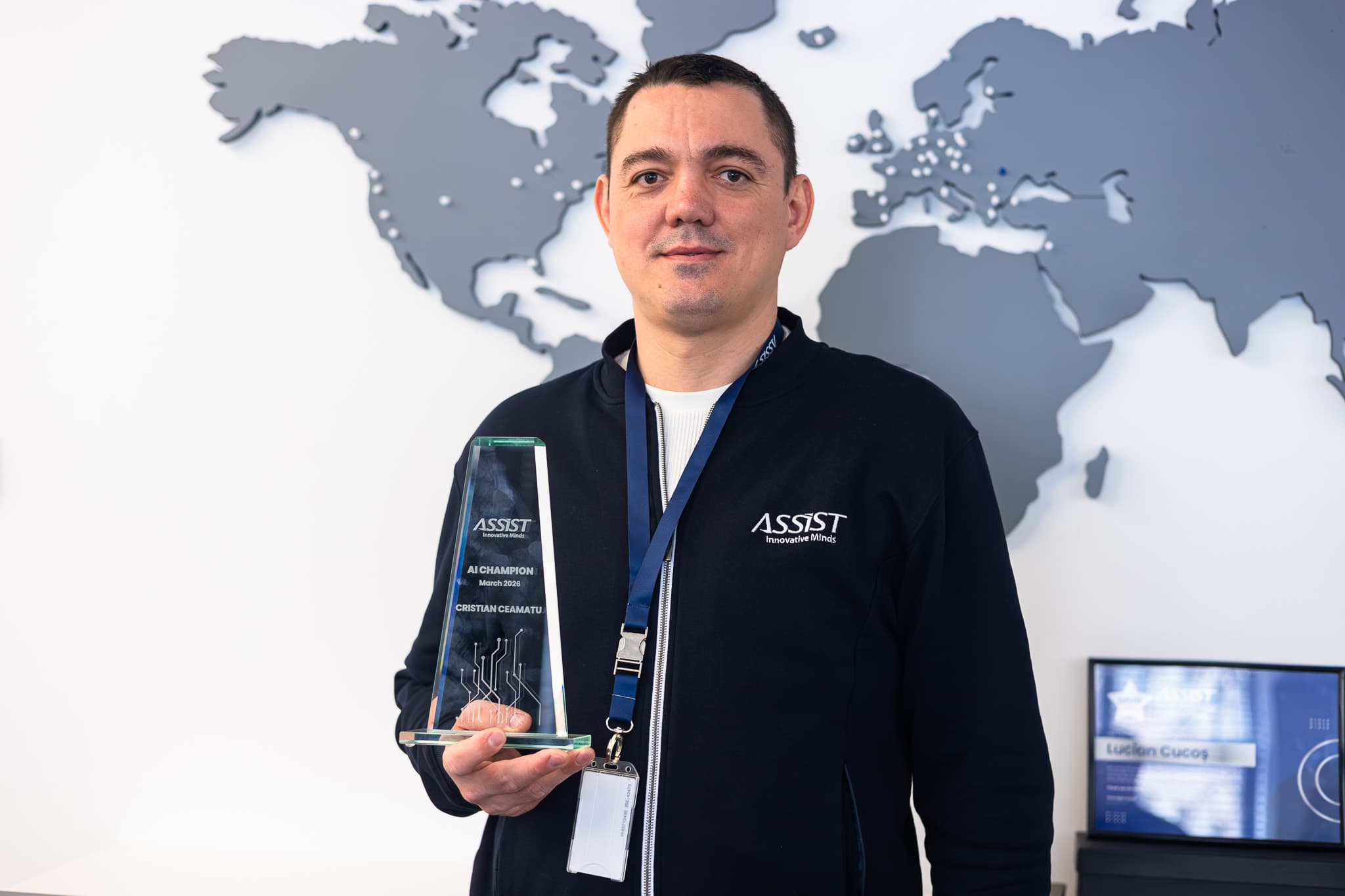
Cristian Ceamatu, Front End Engineer at ASSIST Software, has been named the first AI Champion at ASSIST Software. The recognition reflects a two-year trajectory in which Cristi moved from conventional AI-assisted coding into spec-driven development, built deep expertise in Claude Code on his own initiative, and used that knowledge to measurably improve the output of teams well beyond his own.
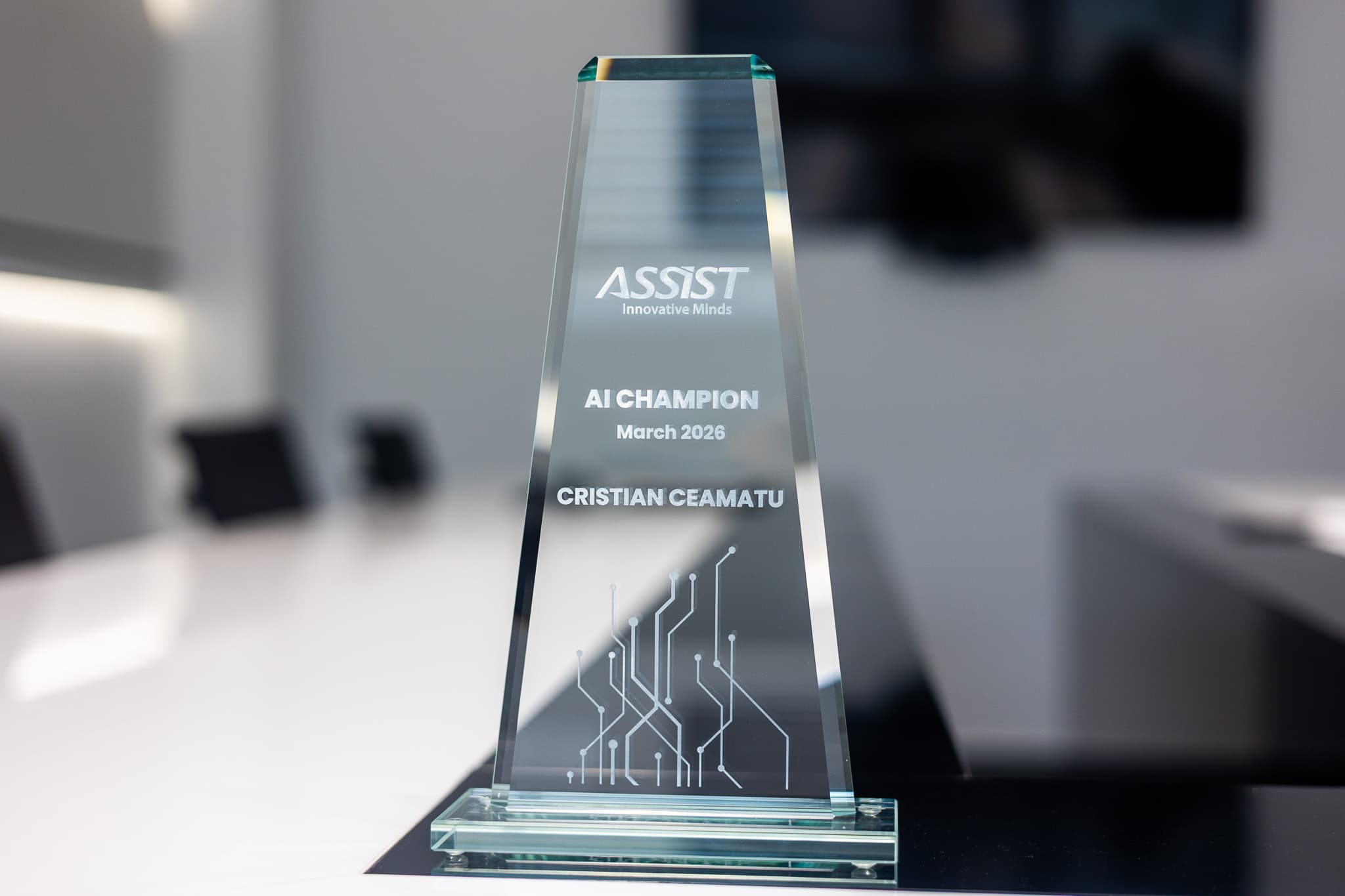
The AI Champion award is an internal ASSIST Software distinction, given through a process of nomination, evaluation, and jury review. It recognizes colleagues whose contributions in AI generate visible results and long-term impact for the entire organization.
Who Is Cristian Ceamatu?
Cristian Ceamatu is a Front End Engineer at ASSIST Software with over ten years of experience in software development. He joined the ASSIST team five years ago and has built a reputation for curiosity, proactivity, and the speed with which he adopts and internalizes new technologies.
His approach to professional development is self-directed by design. When spec-driven development emerged as a meaningful shift in how AI tools could be used in engineering, Cristi didn't wait for a structured program. He built the expertise himself, through practice, iteration, and a willingness to rethink assumptions he had held for a decade.
How Spec-Driven Development Changes the Way Engineers Work with AI
When most engineers were still experimenting with AI coding assistants as glorified autocomplete tools, Cristi was already thinking differently. Approximately two years ago, he began working toward spec-driven development (SDD), a methodology that inverts the traditional engineering starting point.
In conventional software development, code is the primary artifact. In SDD, the specification comes first. Rather than writing code and refining it, Cristi defines the behavior of a project or feature in precise, structured specifications and lets the AI work from those. The shift requires a fundamentally different kind of thinking: less about implementation, more about intent.
Cristi built this specialization independently, using Claude Code as his primary tool. This course demanded that he become, in effect, a spec engineer, someone who thinks not in lines of code but in definitions of processes.
How Spec-Driven Development Extends Impact Beyond Front End
What makes Cristi's contribution particularly notable is its reach. As a Front End Engineer, his core domain is the client-facing layer of an application. But expertise in SDD is not domain-specific; it is a methodology that applies regardless of where in the stack a team is working.
This has made Cristi a go-to resource across ASSIST Software's teams. Besides helping with the technical setup of AI coding tools, he also assists them with the harder questions: how to structure a specification, how to think about behavior before implementation, how to get consistently useful output from an AI model rather than a stream of plausible-sounding noise.
Sharing AI and Spec-Driven Development Across Teams
Cristi's impact at ASSIST Software has not been limited to the projects he directly contributes to. He has delivered internal learning sessions on the use of Claude Code as an AI coding tool, giving colleagues structured exposure to a tool and workflow many had not yet encountered. He also led a masterclass in SDD and Claude Code, a deeper, more technical session designed to equip engineers with the conceptual foundation and practical skills to apply the methodology on their own.
This kind of knowledge transfer is significant. Individual expertise that stays with one person adds value in proportion to that person's capacity. Expertise that spreads through a team, compounds.
What This Recognition Represents
Cristi has worked across startups and enterprise projects, building strong expertise in front end development, AI, and technical SEO. He contributed to ZeroBounce, achieving a perfect SEO score, and helped build the front end for Outbound, a US startup that secured a $5M seed round.
He also worked on AI-driven products like Starea AI and Ciplify, which received $150K in funding from Hedera. At Vela, he developed complex micro front end and offline-capable applications and is currently building an AI-powered chat solution.
Key Insights: Scaling Spec-Driven Development Through Individual Expertise
Cristian Ceamatu is a Front End Engineer at ASSIST Software with 10+ years of software development experience and 5 years at our company. He specializes in spec-driven development using Claude Code, becoming a key internal AI resource. Through presentations and a masterclass, he enabled teams to significantly improve efficiency. He received the AI Champion award for measurable, long-term organizational impact.
As one of the first companies in Europe to hold ISO/IEC 42001:2023 certification for Artificial Intelligence Management Systems, ASSIST Software operates under a formally recognized governance framework for AI development. The standard covers the full lifecycle of AI systems, from planning and development through deployment, monitoring, and continuous improvement, providing clients with concrete assurance that AI initiatives are managed responsibly.
Frequently Asked Questions
1. What is the ASSIST AI Champion award?
The AI Champion is an internal ASSIST Software distinction awarded through a process of nomination, evaluation, and jury review. It recognizes the colleague whose contributions in AI have generated the most visible results and long-term impact for the organization in the relevant period.
2. What is spec-driven development?
Spec-driven development (SDD) is a software engineering methodology in which precise behavioral specifications are defined before any code is written. Rather than starting from implementation and iterating, the developer defines what a project or feature should do, and the AI works from that specification. It requires a shift from code-first thinking to behavior-first thinking.
3. How does SDD differ from vibe-coding?
Vibe-coding involves prompting an AI assistant informally and iterating its output. SDD is a structured alternative: the engineer defines specifications that describe the intended behavior of a system, and the AI generates code from those specifications. The difference is not just methodological; it reflects a different understanding of what engineering work actually is.