AI-Assisted vs AI-Dependent: How Coding Tools Are Reshaping Software Developer Skills
The Role of a Developer Is Shifting
AI-Assisted vs AI-Dependent: A Distinction That Matters
Speed Without Understanding Is a Liability
How Development Teams Should Think About This
What the Tools Won't Tell You
How ASSIST Software Builds Engineering Teams That Understand What They Ship
Frequently Asked Questions
AI coding tools are changing what it means to be a software developer. The distinction that matters most is not which tools a developer uses, but whether they remain in control of what those tools produce. Tools like Copilot, Claude, and Cursor allow developers to generate code in seconds, scaffold entire applications, and move from idea to implementation at a pace that was unthinkable just a few years ago. In many teams, AI already handles a significant part of the development process.
At first glance, this looks like pure progress. And in many ways, it is. But speed was never the real bottleneck in software development; understanding was.
The Role of a Developer Is Shifting
What we are seeing now is not just an increase in productivity. It is a shift in the role itself. Developers are spending less time writing code and more time guiding, reviewing, and validating what AI produces. The act of coding is slowly being replaced by decision-making.
For experienced engineers, this is a powerful upgrade. AI becomes a multiplier. It accelerates execution while preserving the thinking.
But for others, especially those still building their foundations, the effect can be very different. When AI generates most of the code, developers lose opportunities to struggle with problems and, in doing so, to truly understand them. And that is exactly what builds strong engineers.
AI-Assisted vs AI-Dependent: A Distinction That Matters
Not all developers are evolving in the same way. Some are becoming AI-assisted, using these tools to move faster while maintaining control and understanding. Others risk becoming AI-dependent, able to produce results quickly but less equipped to handle complexity when things break, when requirements are unclear, or when systems behave in unexpected ways.
The difference is not in the tools themselves. It is in how they are used.
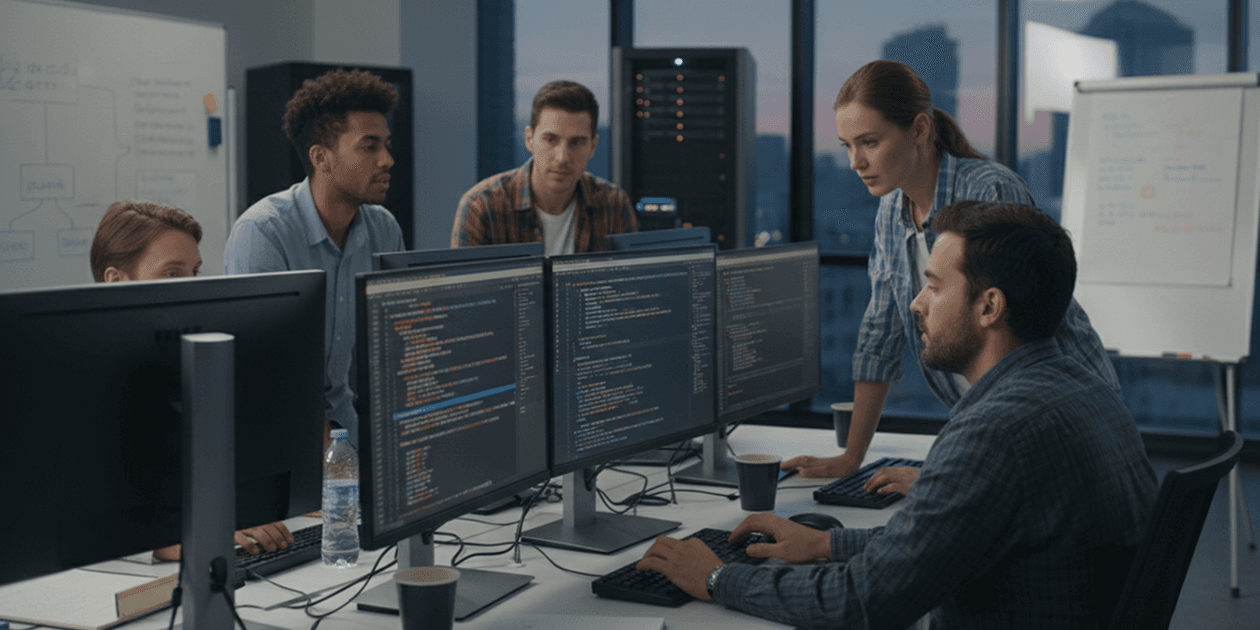
This shift is also quietly widening the gap between junior and senior developers. Senior engineers tend to question AI output. They validate, adapt, and integrate it into a broader architectural vision. They know when something feels off, even if it looks correct.
Less experienced developers are more likely to trust the output at face value. Not because they lack ability, but because they have not yet built the mental models needed to challenge it. The result is a new kind of imbalance: faster onboarding, but potentially shallower understanding. This dynamic is already visible in how engineering teams at scale are approaching AI adoption, with senior engineers leading enablement efforts precisely because junior developers need structured guidance to develop critical judgment alongside speed.
Speed Without Understanding Is a Liability
In controlled environments, this distinction might not seem critical. But in real-world systems, especially in industries such as healthcare, manufacturing, and defense, the stakes are different.
In these contexts, software does not just need to work; it needs to work well. It needs to be reliable, predictable, and safe. Edge cases matter. Assumptions matter. And almost correct is often not acceptable.
AI can help build these systems faster. But it cannot replace the responsibility of understanding them. A developer who cannot reason through what the code is doing, only guides a tool that produces it, is a liability in high-stakes environments, regardless of how fast they ship. At ASSIST Software, where teams work on projects spanning defense simulation, healthcare platforms, and industrial automation, this distinction is not theoretical. It shapes how engineers are expected to engage with AI-generated output from day one.
How Development Teams Should Think About This
The question is not whether to use AI coding tools. At this point, that is settled. The question is how to use them in a way that builds capability rather than eroding it.
For senior engineers, the answer is relatively straightforward: use AI as an accelerator, retain control over architectural decisions, and maintain the habit of understanding what is being generated.
For junior developers and the teams that support them, the answer requires more deliberate design. Onboarding processes, code review culture, and learning environments all need to account for a world where the temptation to accept AI output without scrutiny is constant and the path of least resistance.
The teams that get this right will not just be faster. They will be more capable, more adaptable, and more reliable when it matters most.
What the Tools Won't Tell You
AI coding tools like Copilot, Claude, and Cursor are shifting the developer's role from writing code to guiding, reviewing, and validating AI output. The critical distinction is between AI-assisted developers, who use these tools to move faster while maintaining understanding, and AI-dependent developers, who produce results quickly but struggle when systems break or requirements are unclear.
Senior engineers tend to question and adapt AI output. Junior developers are more likely to accept it at face value, creating faster onboarding but potentially shallower engineering foundations. Bridging that difference is not the job of the tools. It is the job of the teams, the processes, and the engineering culture built around them.
The future of software development will not belong to those who use AI the most. It will belong to those who know when to trust it and when not to.
How ASSIST Software Builds Engineering Teams That Understand What They Ship
At ASSIST Software, AI-assisted development is a practice with defined expectations, not a free-for-all. The difference between understanding a system and merely producing it is not a nuance. It is a risk factor. Engineers working across high-stakes industries such as defense simulation, healthcare platforms, and industrial automation are expected to understand and validate AI-generated output, rather than simply deliver it.
That commitment is now formally recognized: as of 2026, ASSIST Software is ISO 42001 certified, the international standard for AI Management Systems, reflecting a formal, audited commitment to responsible AI use across its engineering operations. For organizations that need software built to that standard, ASSIST Software provides development teams that combine AI-accelerated execution with the engineering depth to own what they build. Reach the team at hello@assist.ro.
ASSIST Software holds ISO/IEC 42001:2023 certification for Artificial Intelligence Management Systems, making it one of the first companies in Europe to do so. The certification confirms that AI development at ASSIST Software is governed by a recognized international framework covering risk management, transparency, accountability, and lifecycle management of AI systems.

Frequently Asked Questions
What is the difference between AI-assisted and AI-dependent developers?
AI-assisted developers use tools like Copilot, Claude, or Cursor to accelerate their work while maintaining control and understanding of what is being produced. AI-dependent developers can generate results quickly but struggle to reason through complexity independently, particularly when systems fail, requirements shift, or edge cases emerge.
How are AI coding tools changing software developer skills?
AI coding tools are shifting the developer's role from writing code to guiding, reviewing, and validating AI-generated output. For experienced engineers, this is an accelerator. For developers still building foundational skills, it reduces the opportunity to struggle with problems directly, which is the process through which deep engineering intuition is built.
Are AI coding tools widening the gap between junior and senior developers?
Yes, in a specific way. Senior engineers have the mental models to question and adapt AI output. Junior developers are more likely to accept it at face value, not because they lack ability but because they have not yet developed the instincts to recognize when something is subtly wrong. This creates faster onboarding but potentially shallower understanding.
How should development teams approach AI coding tools to build rather than erode capability?
Teams need to deliberately design onboarding, code review culture, and learning environments that account for the constant temptation to accept AI output without scrutiny. Senior engineers should maintain ownership of architectural decisions and the habit of understanding what is being generated. The goal is speed and depth, not speed at the expense of depth.