Innovative Skills for Retail Global Expansion

Context
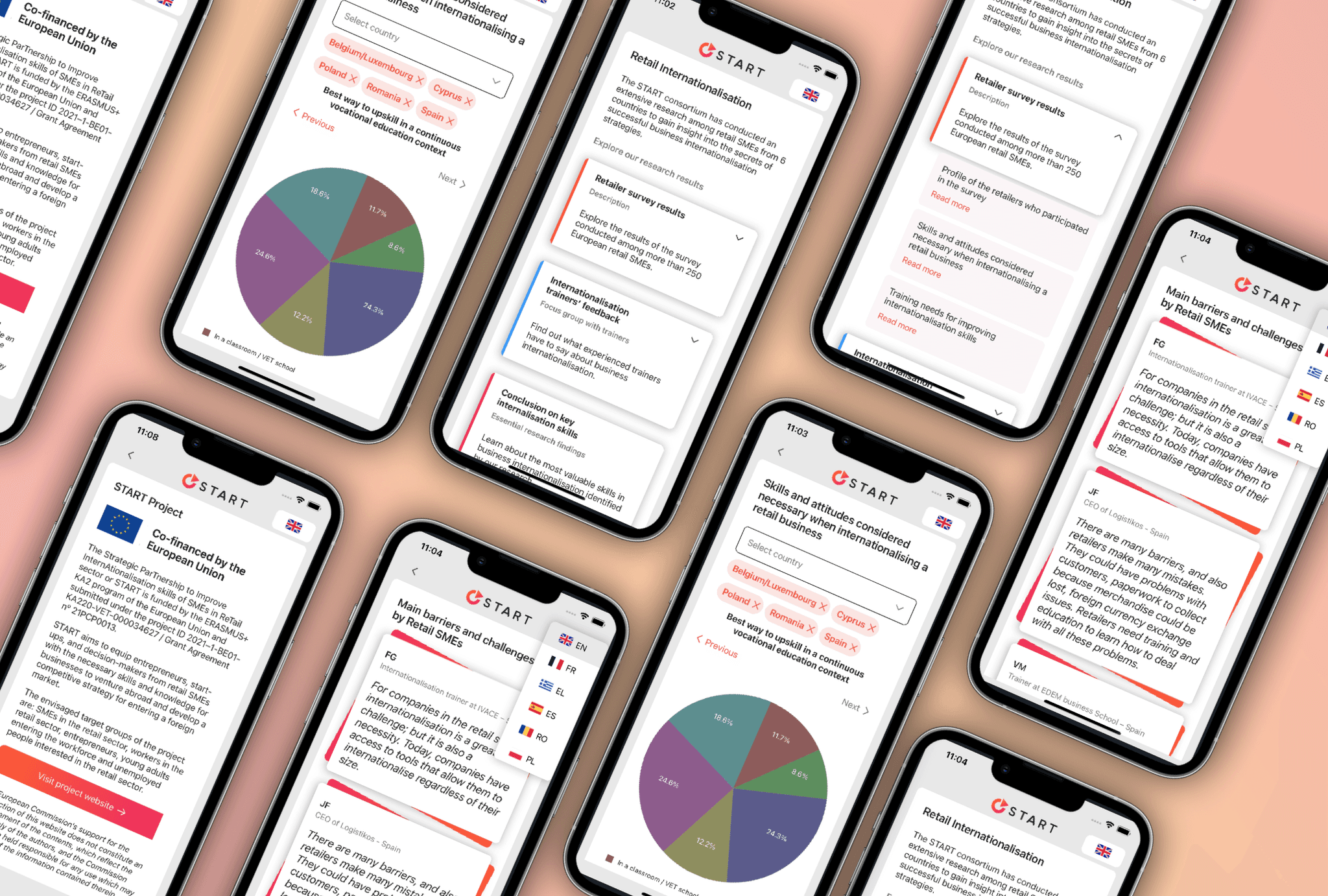
START – Strategic ParTnership to Improve InternAtionalization skills of SMEs in the Retail sector – is funded by the ERASMUS+ KA2 programme of the European Union (Project ID: 2021-1-BE01-KA220-VET-000034627 / Grant Agreement No. 21PCP0013).
The project strengthens the internationalization capabilities of retail SMEs, supporting their expansion into foreign markets. It provides retailers, youth, and unemployed individuals pursuing retail careers with practical tools and strategic knowledge to develop competitive market entry strategies.
Countries:
 BE
BE LU
LU RO
RO ES
ES PL
PL CY
CY Consortium
Services
Engagement
Budget
Funding framework
A digital training platform that equips retail SMEs and professionals with skills and tools for international market expansion.
Helping retail SMEs design and implement strategies to enter foreign markets.
Lack of internationalization and digital competencies among retail SMEs and professionals.
Partners




The Challenge
Retail SMEs and professionals operate in an increasingly international and digital market, yet many lack the skills and strategic knowledge needed to expand beyond domestic borders. There is a clear need for structured training that supports international strategy development and the effective use of modern technologies and e-commerce tools.
Additionally, entrepreneurs, workers, and young or unemployed individuals interested in the retail sector face limited access to targeted training that would enhance employability and competitiveness. Addressing these gaps is essential to support successful internationalization and growth in the retail sector.
Empowering innovation through cutting-edge technologies



Solution Overview
The START project supports current and future retail professionals in developing and implementing effective internationalization strategies through targeted training and the use of modern technologies. It addresses the needs of retail SMEs, entrepreneurs, workers, and young or unemployed individuals interested in the retail sector.
Objectives:
From product design to development & completion. We guarantee exceptional products.


CounteR

JRNI
Scalable, secure and streamlined solutions for your business success
For business inquiries:
hello@assist.ro
Our address:
1 Tipografiei Street 720043, Suceava, Romania
Frequently Asked Questions
1. Can you integrate AI into an existing software product?
Absolutely. Our team can assess your current system and recommend how artificial intelligence features, such as automation, recommendation engines, or predictive analytics, can be integrated effectively. Whether it's enhancing user experience or streamlining operations, we ensure AI is added where it delivers real value without disrupting your core functionality.
2. What types of AI projects has ASSIST Software delivered?
We’ve developed AI solutions across industries, from natural language processing in customer support platforms to computer vision in manufacturing and agriculture. Our expertise spans recommendation systems, intelligent automation, predictive analytics, and custom machine learning models tailored to specific business needs.
3. What is ASSIST Software's development process?
The Software Development Life Cycle (SDLC) we employ defines the stages for a software project. Our SDLC phases include planning, requirement gathering, product design, development, testing, deployment, and maintenance.
4. What software development methodology does ASSIST Software use?
ASSIST Software primarily leverages Agile principles for flexibility and adaptability. This means we break down projects into smaller, manageable sprints, allowing continuous feedback and iteration throughout the development cycle. We also incorporate elements from other methodologies to increase efficiency as needed. For example, we use Scrum for project roles and collaboration, and Kanban boards to see workflow and manage tasks. As per the Waterfall approach, we emphasize precise planning and documentation during the initial stages.
5. I'm considering a custom application. Should I focus on a desktop, mobile or web app?
We can offer software consultancy services to determine the type of software you need based on your specific requirements. Please explore what type of app development would suit your custom build product.
- A web application runs on a web browser and is accessible from any device with an internet connection. (e.g., online store, social media platform)
- Mobile app developers design applications mainly for smartphones and tablets, such as games and productivity tools. However, they can be extended to other devices, such as smartwatches.
- Desktop applications are installed directly on a computer (e.g., photo editing software, word processors).
- Enterprise software manages complex business functions within an organization (e.g., Customer Relationship Management (CRM), Enterprise Resource Planning (ERP)).
6. My software product is complex. Are you familiar with the Scaled Agile methodology?
We have been in the software engineering industry for 30 years. During this time, we have worked on bespoke software that needed creative thinking, innovation, and customized solutions.
Scaled Agile refers to frameworks and practices that help large organizations adopt Agile methodologies. Traditional Agile is designed for small, self-organizing teams. Scaled Agile addresses the challenges of implementing Agile across multiple teams working on complex projects.
SAFe provides a structured approach for aligning teams, coordinating work, and delivering value at scale. It focuses on collaboration, communication, and continuous delivery for optimal custom software development services.
7. How do I choose the best collaboration model with ASSIST Software?
We offer flexible models. Think about your project and see which model would be right for you.
- Dedicated Team: Ideal for complex, long-term projects requiring high continuity and collaboration.
- Team Augmentation: Perfect for short-term projects or existing teams needing additional expertise.
- Project-Based Model: Best for well-defined projects with clear deliverables and a fixed budget.
Contact us to discuss the advantages and disadvantages of each model.