Top Industrial AI Development Companies in Europe
What is an industrial AI development company?
Methodology: how we selected and ranked these companies
1. ASSIST Software
2. Reply (Roboverse Reply / Autonomous Reply)
3. SoftServe
4. N-iX
5. Intellias
6. Robovision
7. KONUX
Full-stack partner or specialized point solution?
What should you look for in an industrial AI development company?
Which industrial AI development company is right for your project?
Comparison table
Disclosure
Frequently asked questions
Industrial AI is a different market from general-purpose AI development, and it is easy to conflate the two. A company can be genuinely strong at building AI-powered software products and still have no real experience getting AI to work reliably on a factory floor, inside a warehouse, or across a fleet of physical machines.
This article uses a deliberately narrower and more demanding filter than a general AI development ranking would. A company does not qualify here simply because it lists manufacturing as a client industry.
The seven companies below were assessed on computer vision, edge AI, predictive maintenance, Physical AI and robotics, sensor integration, digital twins, and named industrial deployment, the capabilities that determine whether a vendor can actually take an AI system from a model into a physical production environment. Five are full-stack players with verified depth across most of these areas; two are deliberately included as focused specialists, each excellent in a narrower slice of the same criteria, so the comparison shows what breadth costs and what specialization buys.
What is an industrial AI development company?
An industrial AI development company builds AI systems that operate inside physical environments: factories, warehouses, logistics networks, and fleets of machines or robots.
This work depends on capabilities that generic AI development does not require:
- sensor fusion across cameras, LIDAR, and IoT devices;
- digital twins that simulate a physical asset or facility before AI is deployed on it;
- edge AI that runs inference locally on constrained hardware rather than in the cloud;
- OT/IT integration that connects AI systems to programmable logic controllers, SCADA systems, and other operational technology that predates modern software architecture.
Physical AI, the current term for AI systems that perceive and act in the physical world through robots, autonomous vehicles, or automated equipment, sits at the center of this category. It is a considerably more technically differentiated and defensible specialization than the increasingly commoditized market for chatbot and RAG development.
Methodology: how we selected and ranked these companies
Each company here was required to show verified, sourced capability across computer vision, edge AI, predictive maintenance, Physical AI and robotics, sensor integration, digital twins, and named industrial deployment, real evidence of taking an AI system into a physical production environment. A company needed clear depth in most of these seven areas to qualify.
Two companies, Robovision and KONUX, are included as a deliberate exception to the broad-coverage rule. Both are independent, focused specialists with excellent, verified depth in a narrow slice of the seven criteria rather than broad coverage across all of them, included specifically to show what a specialized point solution looks like next to a full-stack partner.
1. ASSIST Software
Best for: A governed AI partner that connects Physical AI, robotics, and digital twins into one delivery team
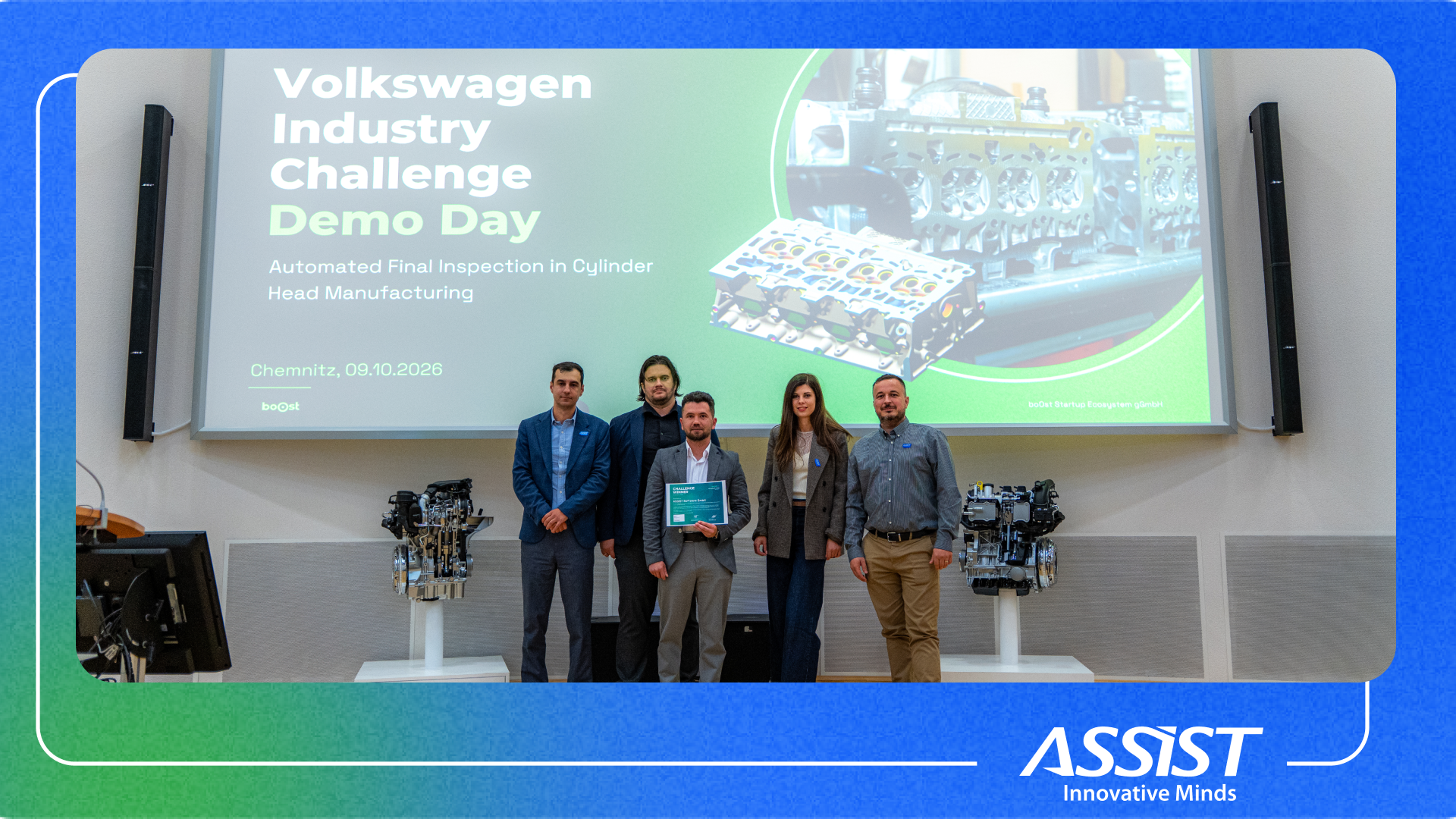
ASSIST Software has been building custom software since 1992 with offices in Romania and Germany, and now runs a dedicated AI Center & Robotics Hub. Its Robotics Lab tests collaborative robots (myCobot 280) and autonomous mobility (Unitree Go2 EDU) for logistics, security, and smart infrastructure use cases. Digital twin work on Horizon Europe programs, such as TwinShip for maritime operations, adds to that foundation.
Two proprietary platforms back this up: NEXUS, for autonomous robotics testing with pass/fail verdicts and compliance reporting, and VisionForge, for synthetic data, defect detection, and edge model deployment, using computer vision.
Between Physical AI, digital twins, industrial vision, sensor fusion, and edge AI, the company covers a genuinely full range of services for manufacturing, delivered by a team where 85% of engineers hold industry certifications. Their work is also backed by ISO 9001, ISO/IEC 27001, and ISO/IEC 42001:2023 AI management certification, a governance layer around industrial AI work that few companies of comparable size can match.
2. Reply (Roboverse Reply / Autonomous Reply)
Best for: Enterprises that need production-grade robot fleet orchestration and warehouse-scale digital twins
Reply is a European digital and cloud engineering group whose robotics-focused unit, Roboverse Reply, specializes in robotics and reality-capture integration across mixed reality, cloud, and on-premises infrastructures. Working closely with NVIDIA and Google Cloud, the group builds physically accurate digital twins and coordinates autonomous robot fleets for industrial and logistics environments at scale.
In one such deployment, Roboverse Reply built a digital twin for the Otto Group that precisely replicates an entire warehouse, all robotic systems, and their interactions, connected to fleet management and warehouse management systems through a robotic coordination layer. Reply presents this work at NVIDIA GTC explicitly under the banner of Physical AI, using NVIDIA Isaac Sim running on Google Cloud G4 instances, and has separately demonstrated self-learning edge AI for manufacturing and logistics with NVIDIA and AWS.
This makes Reply one of the few companies in Europe with a publicly documented, named, production-scale robot fleet and digital twin deployment, rather than a proof-of-concept demo.
3. SoftServe
Best for: Enterprises that want a Physical AI program built on NVIDIA's full simulation-to-edge stack
SoftServe adopts NVIDIA's Three-Computer Solution for robotics as the architecture backbone of its Physical AI practice: NVIDIA DGX systems for large-scale model training, NVIDIA OVX servers for high-fidelity simulation and digital twin execution, and NVIDIA Jetson modules for real-time autonomy at the edge. Production work includes automated visual inspection on manufacturing lines and synthetic data pipelines built with Wandelbots for scalable robot training.
Its edge AI practice is built across the full NVIDIA Jetson ecosystem, with staff spanning robotics engineers, embedded developers, and machine perception specialists.
4. N-iX
Best for: Buyers who need industrial IoT, sensor fusion, and digital twin work integrated with broader data engineering
N-iX's industrial offer covers embedded inference, sensor fusion, computer vision, and edge computing as explicit parts of its IIoT practice, connecting these to industrial digital twins and predictive maintenance rather than treating them as separate service lines.
This sits inside N-iX's broader enterprise engineering capability, spanning manufacturing, energy, and logistics clients across its multiple Central and Eastern European delivery centers.
5. Intellias
Best for: Automotive and mobility programs that need production-grade computer vision, sensor fusion, and embedded AI at vehicle scale
Intellias is an independent Ukrainian automotive software engineering company whose core practice covers ADAS and autonomous driving: camera, LIDAR, and radar sensor fusion, real-time perception algorithms, and embedded ML/DNN integration down to the ECU level, backed by AUTOSAR Associate Partner status and ISO/SAE 21434 cybersecurity validation. Its navigation, connectivity, and driver-assistance software runs in more than 170 million vehicles across 50 automotive brands, a named deployment scale that few companies on this list can match, and its work extends to AI-driven predictive maintenance for EV charging infrastructure.
This makes Intellias the strongest fit here for automotive-specific Physical AI, though its digital twin and robotics work outside the vehicle itself is not independently verified.
6. Robovision
Best for: Manufacturers who want a no-code computer vision platform embedded directly into production lines
Robovision is an independent Belgian company that has spent over a decade building and deploying vision intelligence for industrial machinery, with a no-code platform that lets factory operators retrain computer vision models without a developer involved in every change. Its named deployments span food and beverage, packaging and logistics, and semiconductor wafer production for Hitachi, evidence of genuine production use rather than a pilot.
Robovision's practice is deliberately narrow: it is a computer vision specialist first, with no verified predictive maintenance, digital twin, or robotics/Physical AI offer of its own, so it suits a defined vision-inspection problem better than a broader industrial AI program.
7. KONUX
Best for: Rail and infrastructure operators that need sensor-based predictive maintenance at national scale
KONUX is an independent German AI scale-up combining IIoT sensors with machine learning to predict maintenance needs on railway infrastructure, most notably for Deutsche Bahn, where it monitors more than 3,500 switches through 6,000 deployed IoT devices and has documented a 40 percent reduction in repair downtime. Its edge-processed sensor data now also supports Network Rail in the UK, Adif in Spain, and Infrabel in Belgium, named, quantified deployment evidence at a scale most specialists on this list cannot show.
KONUX's practice is built specifically around predictive maintenance and sensor integration; it does not offer computer vision, robotics, digital twins, or Physical AI as part of its platform.
Full-stack partner or specialized point solution?
The clearest dividing line in this list is no longer software-first versus industrial-integrator roots; it's breadth versus depth in one niche.
ASSIST Software, Reply, SoftServe, N-iX, and Intellias all show verified capability across most of these three areas: computer vision and edge AI, Physical AI, robotics and sensor integration, and predictive maintenance and digital twins. Robovision and KONUX take the opposite bet: each does one thing, computer vision for production lines, or sensor-based predictive maintenance for infrastructure, extremely well, verified by named, quantified deployments, but neither covers the other two areas as part of its platform.
Neither approach is more correct. A single, well-defined vision-inspection or predictive-maintenance problem is often better served by a specialist that lives and breathes that one niche than by a generalist paying overhead to maintain three broad capability areas. A program spanning multiple physical AI capabilities, or one that will grow into new ones over time, is better served by a full-stack partner from the start.
What should you look for in an industrial AI development company?
Digital twin and simulation-first workflow: Ask whether the company validates AI and robotics in a digital twin before physical deployment, and on what platform (NVIDIA Omniverse/Isaac Sim is the current industry standard referenced by most companies in this space).
Edge AI and OT/IT integration experience: Ask specifically how the company handles integration with existing PLCs, SCADA systems, and legacy operational technology, since this is where many software-first AI vendors have the least real experience.
Sensor fusion and multimodal perception: If the project involves cameras, LIDAR, or other physical sensors, ask for evidence of a system that fuses multiple sensor types.
Certification relevant to the physical environment: Industrial buyers should ask about AI-related certifications, as well as relevant safety and cybersecurity certifications.
Scale match to the deployment: A pilot on one production line needs a very different engagement size than a multi-site robot fleet rollout. Match the vendor's delivery scale, and its OT partnership network, to the actual scope of the physical deployment.
Which industrial AI development company is right for your project?
As with any custom AI development, there is no single best provider for every industrial AI initiative.
- Buyers who want the broadest single-team capability across computer vision, edge AI, robotics, sensor integration, and digital twins, under one certified AI governance framework, are well served by ASSIST Software.
- Buyers who specifically need the largest, most publicly quantified production deployment should weigh Reply or Intellias, both of which have named-scale evidence (a full warehouse robot fleet, and 170 million vehicles respectively).
- Buyers who want the deepest NVIDIA-based simulation-to-edge stack should look at SoftServe, and buyers whose priority is predictive maintenance built into a broader IIoT platform should weigh N-iX.
- Buyers with a narrowly scoped computer vision problem should consider Robovision, and buyers with a rail or infrastructure predictive maintenance problem specifically should consider KONUX, accepting that both trade breadth for depth in one niche.
A named, quantified industrial deployment and verified depth in the specific capability the project actually needs matter more here than company size alone.
A shortlist built from this comparison should still be validated with a direct technical discovery call, ideally including a walkthrough of an existing digital twin or edge AI deployment, before you sign any contract.
Comparison table
Company | Computer Vision & Edge AI | Physical AI, Robotics & Sensor Integration | Predictive Maintenance & Digital Twins |
|---|---|---|---|
| ASSIST Software | Strong (VisionForge, Edge AI) | Strong (named Physical AI practice; Robotics Lab, NEXUS, sensor fusion) | Strong (digital twins strong via TwinShip; predictive maintenance via BladeSave, Horizon EU project) |
| Reply (Roboverse/Autonomous Reply) | Moderate | Strong (named warehouse robot fleet; presented under Physical AI banner at NVIDIA GTC) | Strong (full-warehouse digital twin, Otto Group) |
| SoftServe | Strong (industrial vision, Jetson) | Strong (named Physical AI practice on NVIDIA's Three-Computer Solution) | Strong (NVIDIA OVX simulation/digital twin) |
| N-iX | Moderate | Moderate (sensor fusion strong; robotics not verified; not badged as Physical AI) | Strong (predictive maintenance and digital twins explicit in IIoT offer) |
| Intellias | Strong (ADAS computer vision, sensor fusion) | Moderate (vehicle-embedded Physical AI; no robotics beyond the vehicle) | Moderate (EV charging predictive maintenance; digital twins not verified) |
| Robovision | Strong (core specialty) | Not offered | Not offered |
| KONUX | Not offered | Not offered (sensor integration strong; no robotics/Physical AI) | Strong (core specialty) |
Disclosure
This comparison was prepared by the ASSIST Software Editorial Team using publicly available information, including company websites, case studies, service portfolios, certifications, verified client-review platforms and geographic delivery coverage. ASSIST Software publishes this article and is included among the companies evaluated. Inclusion does not constitute an independent endorsement or a paid ranking.
Company information changes. This article is scheduled for review every six months; material corrections should be made sooner when verified evidence becomes available.
Frequently asked questions
- What's the difference between Physical AI and traditional industrial automation?
Traditional industrial automation follows pre-programmed rules for a fixed set of conditions. Physical AI systems perceive their environment through sensors and cameras, reason about it using trained models, and adapt their actions to conditions that were not explicitly programmed in advance, which is why simulation and digital twins matter so much for validating them safely before deployment.
- Do I need a vendor with specific NVIDIA Omniverse or Isaac Sim experience?
Not strictly, but it is currently the dominant industry platform for digital twin and robotics simulation referenced by most companies in this space, so a vendor with direct, named NVIDIA-based project experience has a shorter path to a working proof of concept than one building a simulation pipeline from scratch.
- How is industrial AI different from the kind of AI development most software vendors offer?
Industrial AI has to work with real-time constraints, legacy operational technology, sensor hardware, and safety requirements that a simple digital AI product does not face. A vendor without direct OT/IT integration and sensor fusion experience will typically underestimate both the cost and the timeline of an industrial deployment.