Everyone Can Build an AI Pilot. Almost Nobody Can Land One.
A year ago, getting an AI prototype in front of stakeholders took months. Now it takes days. That shift is real, and it matters. But it has also moved the problem: the bottleneck is figuring out what to do with it once it does.
Why AI Pilots Rarely Survive Contact with the Rest of the Business
Once something works in a contained setting, a different set of questions appears. Where does this fit in our existing process? How does it connect to the systems already running? Who is responsible for it when something goes wrong?
These questions don't have clean answers, and they rarely come up during a pilot. Pilots are designed to test whether something works. They're not designed to test whether an organization is ready to depend on it.
That gap is where many AI initiatives currently sit. The experimentation phase is over. Full integration hasn't happened. And the path between the two turns out to be longer and more complicated than most teams anticipated.
Why AI Models Underperform in Production Environments
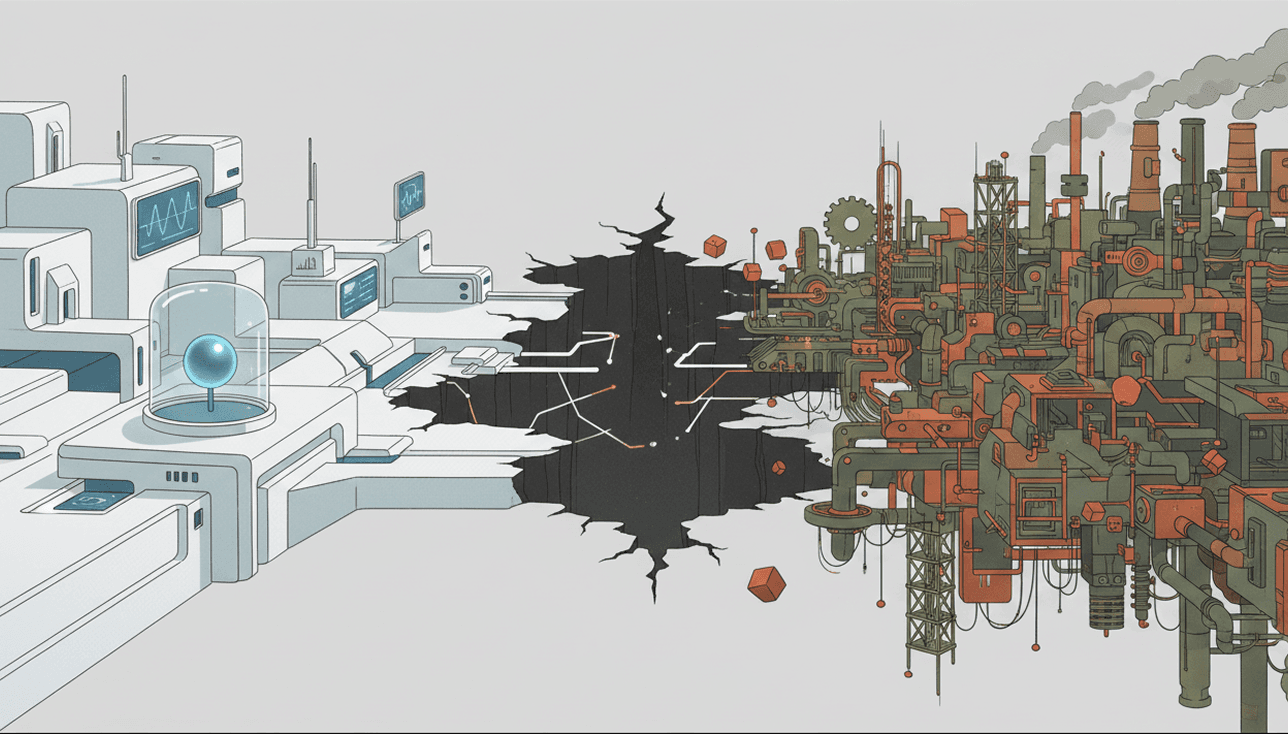
A solution that performs well in a sandbox behaves differently once it's connected to real infrastructure. Data that looked clean during testing turns out to be inconsistent across sources. Systems that were supposed to communicate don't always do so reliably. Processes that seemed standardized vary significantly across teams, locations, and even times of day.
This isn't something unique to a particular industry or company size. Across sectors and organizations, the same pattern keeps emerging. The technical solution holds up, but the environment around it is more complex than the pilot accounted for. Closing that gap takes real work: properly connecting systems, structuring data so it behaves consistently, and building the monitoring needed to catch problems before they affect operations.
This is also where ownership becomes critical, and where it's most often missing. During a pilot, responsibility is relatively informal. Someone championed the idea, a small team built it, and everyone agreed to see how it goes. But once something moves toward daily use, that informal structure stops working. Someone needs to own it, maintain it, and be accountable for it. When that person or team isn't identified early, progress tends to slow down or stop entirely.
Why AI Projects Lose Momentum After a Successful Proof of Concept
There's a pattern that recurs across industries. An initiative gets started, often driven by a general push to explore what AI can do. A prototype is built. It works well enough. And then it sits.
Most of the time, the prototype worked fine. It just never had a real home. No specific process was meant to improve, no measurable outcome was attached to it, and no one whose daily work it was supposed to change. Without that, there was never a clear reason to push it further.
When a project isn't anchored to a concrete problem, it's hard to know what comes next. You can demonstrate that the technology works, but you can't easily show that it matters. And without that, the momentum that carried the pilot rarely survives contact with the rest of the organization.

What Good AI Adoption Looks Like
What leadership, operations, and end users expect from AI projects has shifted. Demonstrating that something works in a demo carries less weight than it did a year ago. The questions being asked now are more grounded: does it hold up over time, does it fit existing workflows, and who is accountable when something breaks?
The teams making consistent progress share a few characteristics. They treat deployment as the core of the project, not a phase that follows it. They define what operational success looks like before the pilot starts, bring in the people who will own the solution while it's still being built, and plan for integration with the same rigor they apply to the model itself.
It's the same discipline we apply at ASSIST Software, whether we're working on defense simulation systems, industrial automation, or healthcare platforms. The technical solution is rarely the constraint. The system around it is. That approach produces fewer impressive demos and significantly more deployed, working software.
If your organization is navigating that gap between pilot and production, we'd like to talk.
ASSIST Software holds ISO/IEC 42001:2023 certification for Artificial Intelligence Management Systems, making it one of the first companies in Europe to do so. The certification confirms that AI development at ASSIST Software is governed by a recognized international framework covering risk management, transparency, accountability, and lifecycle management of AI systems.
Frequently Asked Questions
1. Why do many AI pilots fail after a successful proof of concept?
Many AI pilots fail because they are not connected to a clear business process, measurable outcome, or long-term owner. A prototype may work well in a controlled environment, but without integration, accountability, and operational relevance, it often loses momentum.
2. What makes AI models underperform in production?
AI models often underperform in production because real business environments are more complex than sandbox conditions. Data may be inconsistent, systems may not communicate reliably, and workflows can vary across teams or locations.
3. What does successful AI adoption require?
Successful AI adoption requires planning for deployment from the start. Teams need to define operational success, involve the people who will own the solution, prepare for system integration, and build monitoring to ensure the AI solution performs reliably over time.