Europe's AI Strategy: Regulatory Constraint or Strategic Competitive Advantage?
The global AI narrative paints regions in broad strokes: Silicon Valley innovates rapidly, China deploys at scale, and Europe regulates cautiously. But is Europe falling behind in artificial intelligence, or building something more durable?
The answer depends on what we believe the AI race is actually about.
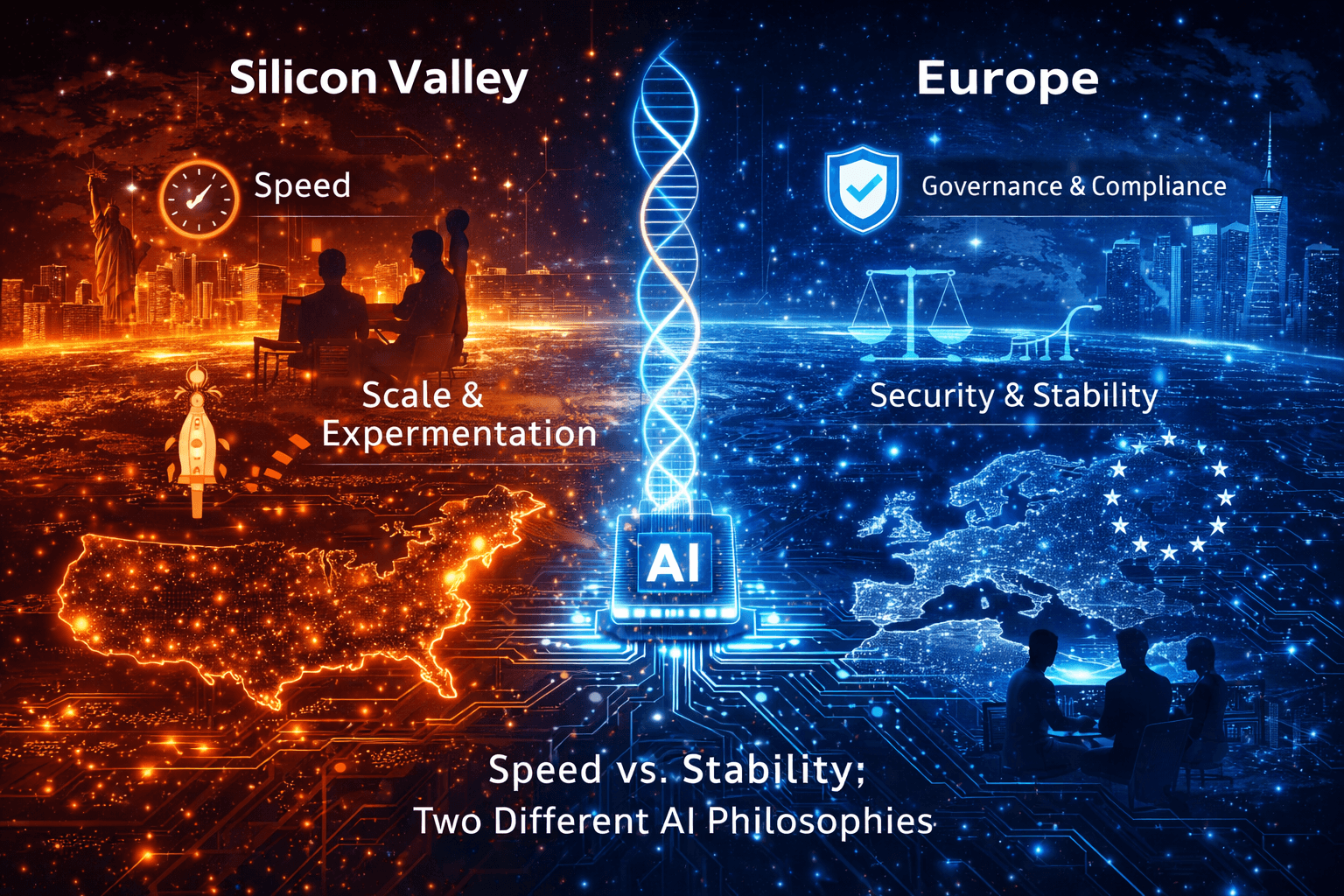
Silicon Valley's venture-backed ecosystem prioritizes rapid deployment, public iteration, and market-driven experimentation. European AI development follows different principles. The EU AI Act, which entered into force on August 1, 2024, establishes the world's first comprehensive legal framework for AI development and deployment European Commission, requiring systems to meet stringent standards for security, explainability, and societal alignment.
To some, this looks like hesitation. To enterprise buyers managing operational risk, it represents governance maturity.
What Enterprise AI Actually Requires
Enterprise AI deployment depends on operational questions that don't generate headlines but determine success:
- How do we ensure data security across jurisdictions?
- Can AI decisions be audited and explained to regulators?
- How does AI integrate with legacy infrastructure?
- Who is accountable for AI performance and risk?
- What measurable business outcomes does this deliver?
These operational requirements shape deployment decisions more than model benchmarks. This is where Europe's regulatory-first approach may create differentiation rather than disadvantage.
The European AI Ecosystem
Europe produces world-class AI innovation, though strategic focus differs from US competitors:
Leading European AI Companies:
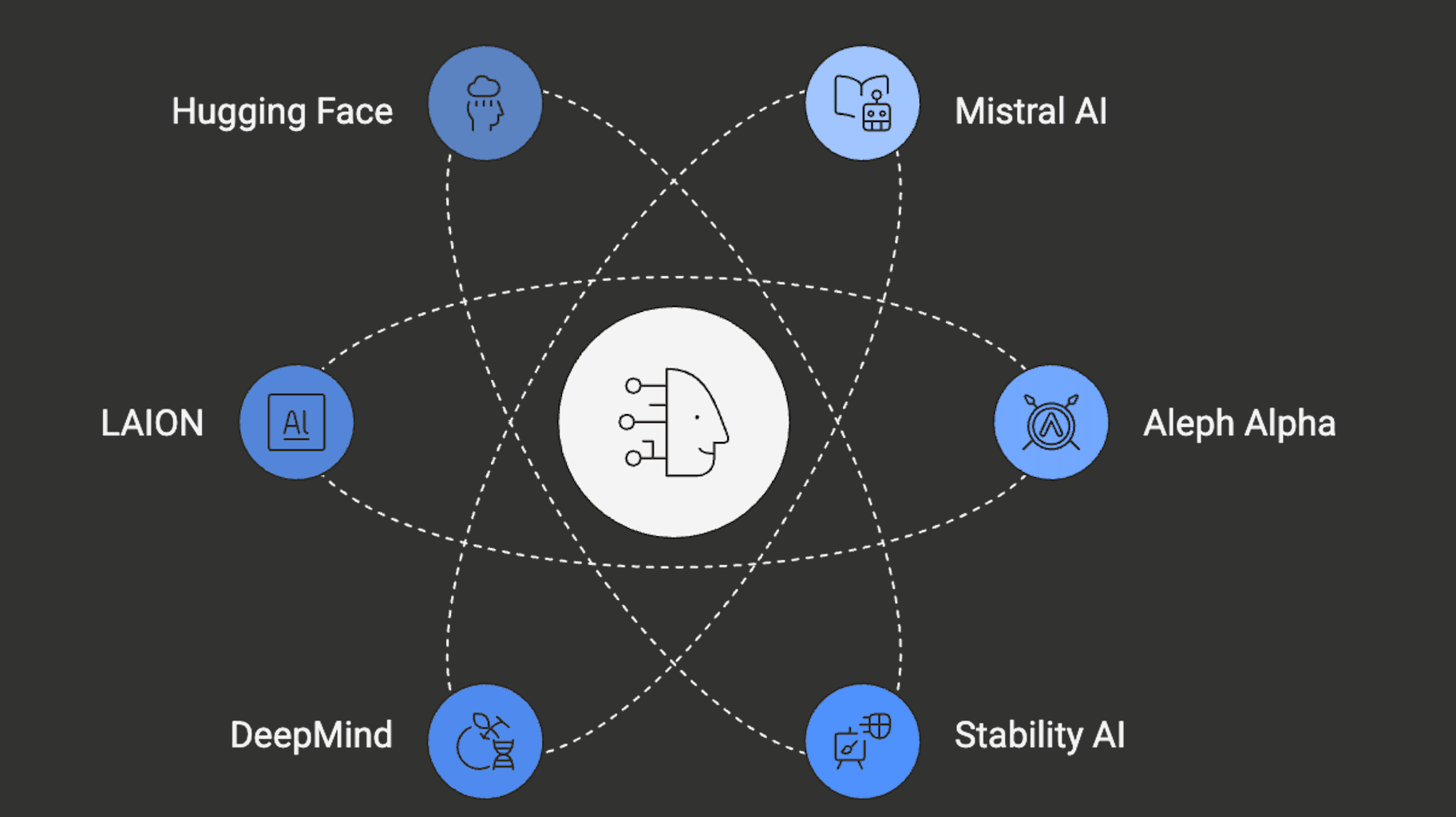
- Mistral AI (France): Raised close to $2 billion in 2025, led by Dutch chip manufacturer ASML Crunchbase News, developing open-source LLMs rivaling OpenAI
- Aleph Alpha (Germany): Building sovereign AI infrastructure for European regulations
- Stability AI (UK): Created Stable Diffusion, democratizing generative AI
- DeepMind (UK): Achieved breakthrough scientific applications, including AlphaFold
- LAION (Germany): critical open datasets for AI research
- Hugging Face (France): Provides essential infrastructure for open-source AI development
Investment momentum is accelerating: AI investment in Europe reached approximately $17.5 billion in 2025, up from just over $10 billion in 2024, making it the leading sector for venture investment in Europe for the first time, according to Crunchbase News. However, between 2020 and 2025, the US dedicated 34% of its €1.33 trillion in VC funding to AI, while Europe allocated 18% of €252 billion to AI.
Enterprise Adoption: Current State
In 2025, 19.95% of EU enterprises used AI technologies, with adoption reaching 55.03% among large enterprises (Eurostat). Geographic disparities are substantial: adoption ranges from 42.03% in Denmark and 37.82% in Finland to 5.21% in Romania and 8.36% in Poland.
Text mining is the most commonly used AI technology, deployed by 11.75% of EU enterprises, followed by generative AI for creating pictures, videos, and audio at 9.55%.
EU AI Act: Framework and Timeline
Implementation follows a phased timeline: prohibited AI practices became enforceable on February 2, 2025; governance rules and GPAI model obligations took effect on August 2, 2025; high-risk AI system requirements apply from August 2, 2026 (European Commission).
The Act establishes four risk tiers:
Prohibited (Unacceptable Risk): Social scoring, untargeted biometric scraping, workplace emotion recognition
High-Risk: Applications in biometrics, critical infrastructure, education, employment, law enforcement, migration, justice Yousign requiring conformity assessments, CE marking, quality management, and EU database registration
Limited-Risk: Transparency disclosure requirements
Minimal-Risk: No specific AI obligations
Penalties reach up to €35 million or 7% of global annual turnover for prohibited practices; up to €15 million or 3% for other violations; and up to €7.5 million or 1% for providing incorrect information DLA Piper.
The Hidden Costs of Speed Without Governance
Rapid deployment without governance carries measurable risks:
- Regulatory exposure: GDPR violations plus AI Act non-compliance
- Operational failures: Model hallucinations in high-stakes workflows
- Security vulnerabilities: Production system breaches
- Reputational damage: AI failures destroying enterprise value
For European companies operating cross-border, these aren't theoretical risks—they're operational realities that governance frameworks prevent.
Redefining AI Leadership
If AI leadership means launching the most models, Europe trails. If leadership means building reliable, secure, enterprise-grade AI systems that operate across regulatory jurisdictions and integrate with complex infrastructure, the picture changes.
European AI strategy emphasizes:
- Cross-ecosystem interoperability
- Built-in accountability and audit mechanisms
- Long-term maintainability
- Multi-jurisdictional compliance from inception
- Enterprise infrastructure compatibility
These capabilities matter decisively in enterprise environments, which account for most of the global value of AI deployment.
ASSIST Software's Dual-Capability Approach
Operating at the intersection of Romania's engineering ecosystem and Germany's enterprise market while serving global clients, ASSIST Software demonstrates that governance and velocity aren't mutually exclusive.
Our teams build computer vision pipelines, NLP models, and predictive analytics with startup agility for US clients. When those systems operate in European markets, they're architected from inception to meet GDPR, security, explainability, and regulatory requirements.
As the first Romanian company to initiate ISO/IEC 42001 AI Certification, we've embedded responsible AI governance into operational DNA not as a compliance afterthought, but as a foundational capability that enhances trust and accelerates enterprise adoption.
The competitive advantage isn't choosing between speed and governance. It's mastering both.
Clients worldwide increasingly request "fast deployment with European-grade security" AI systems that launch quickly while withstanding regulatory scrutiny, integrating with complex enterprise infrastructure, and scaling responsibly across jurisdictions.
Strategic Assessment
Is Europe behind in AI? It depends on the measurement criteria.
If leadership means rapid consumer product innovation, Europe moves differently by design. If leadership means building AI systems that work across regulatory environments, scale responsibly, meet enterprise-grade security standards, and maintain competitive development speed, Europe may be playing a smarter long game.
Critical open questions:
- Can Europe retain AI talent and scale competitive companies despite funding gaps?
- Can regulatory frameworks adapt to enable innovation rather than just constrain it?
- Can governance-first positioning translate into measurable market value?
Frequently Asked Questions
When does the EU AI Act take full effect?
The AI Act entered into force on August 1, 2024, with phased implementation: prohibited AI practices became enforceable February 2, 2025; governance rules took effect August 2, 2025; and high-risk AI system requirements apply from August 2, 2026 European Commission. Different obligations have different timelines to allow organizations time to achieve compliance.
2. What are the penalties for EU AI Act violations?
Penalties reach up to €35 million or 7% of global annual turnover for prohibited AI practices; up to €15 million or 3% for other obligation violations; and up to €7.5 million or 1% for supplying incorrect information to authorities DLA Piper. These penalties apply to both EU and non-EU companies placing AI systems on the European market.
3. How widespread is AI adoption in European enterprises?
In 2025, 19.95% of EU enterprises used AI technologies, with significantly higher adoption among large enterprises at 55.03% (Eurostat). Adoption varies considerably by country and industry sector, with information and communication companies leading with over 60% adoption.
4. Does the EU AI Act apply to companies outside Europe?
Yes. The EU AI Act has extraterritorial reach, similar to GDPR. Any company placing AI systems on the EU market or whose AI systems affect people in the EU must comply with the regulation, regardless of where the company is headquartered. This includes US, Asian, and other international AI providers serving European customers.
Conclusion
Artificial intelligence is now an integral part of decision-making. AI's future will be shaped not only by who moves first, but by who builds systems organizations can trust, maintain, and evolve.
Europe's approach may look cautious externally. In enterprise environments, managing operational risk and long-term maintainability often appears deliberate and strategically grounded.
The AI systems organizations ultimately deploy require both speed and compliance. Long games built on dual capabilities often matter more in enterprise technology than early velocity alone.
As one of the first companies in Europe to hold ISO/IEC 42001:2023 certification for Artificial Intelligence Management Systems, ASSIST Software operates under a formally recognized governance framework for AI development. The standard covers the full lifecycle of AI systems, from planning and development through deployment, monitoring, and continuous improvement, providing clients with concrete assurance that AI initiatives are managed responsibly.