The Pipeline Behind modeling, animating and integrating the Flak 88 AA Gun in Zelgor

Date published: January 24, 2014
8 min read
Introduction

Modelling a Flak 88 AA Gun or any mechanical model requires a different approach from modeling a character due to the technical and physical requirements that come along with creating a game ready weapon.

To make things more interesting I divided this presentation in two core components: the text part were I will focus on the more technical aspects of the pipeline and a video presentation that will cover the workflow behind the flak 88 in a more dynamic and easy to understand style. As with the building pipeline of the World War 2 soldier, I divided the process in eight distinct segments, with the size of each part representing the time spent in it.
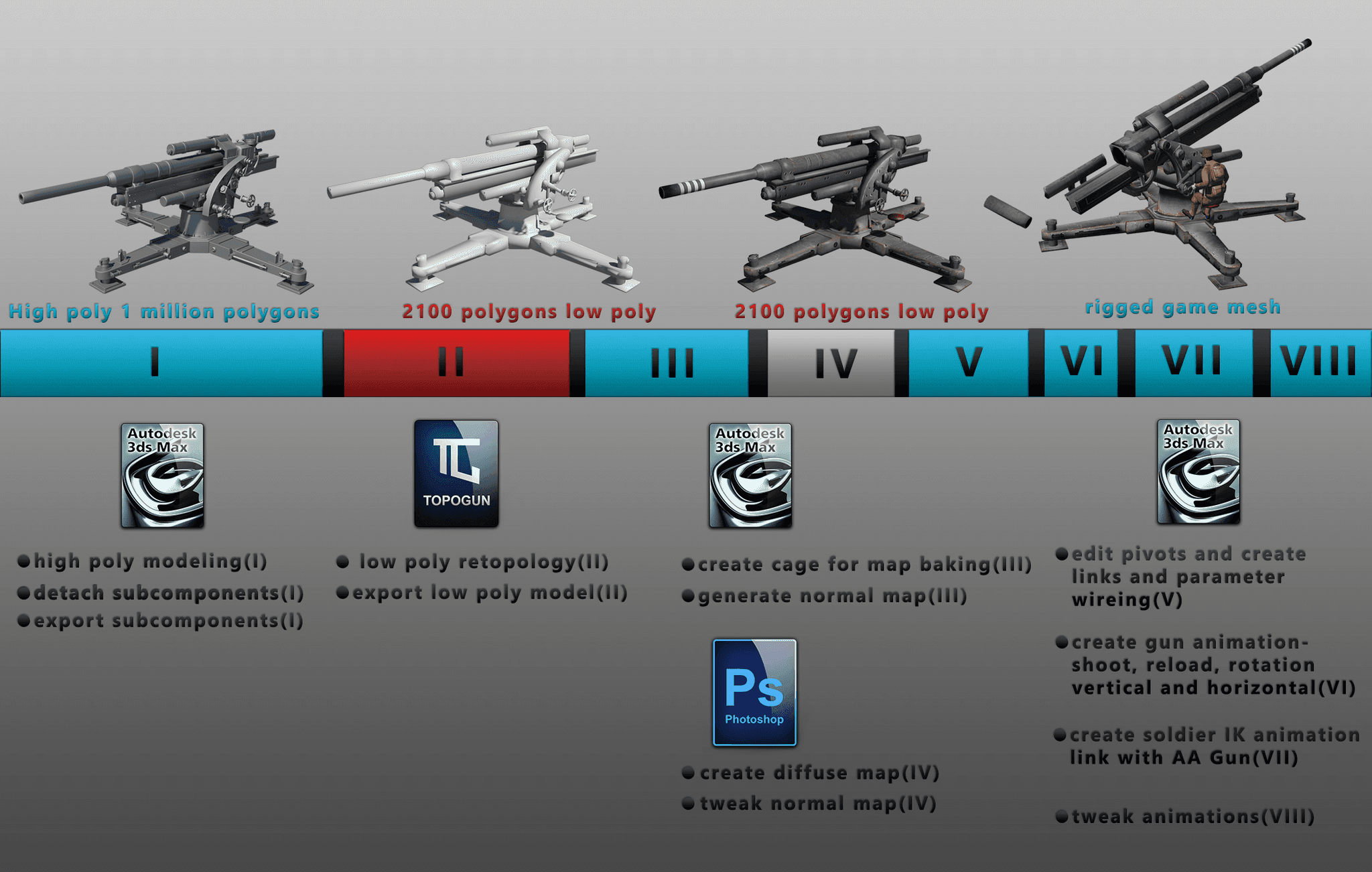
Flak creation pipeline

In addition to the pipeline I added a workflow image that is focused on the big picture, and in some ways it can be seen as an alternative to the pipeline image above.
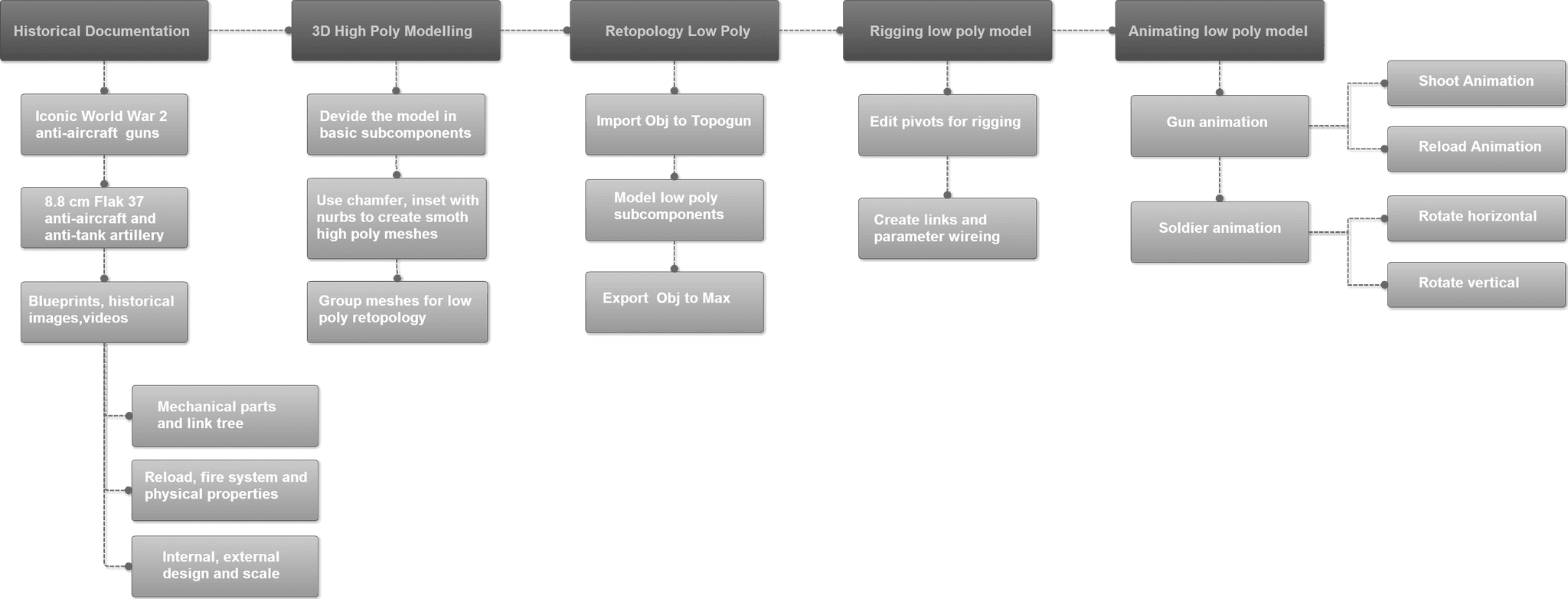
Workflow
Historical Documentation

Before starting the modelling process, the first step is to understand how the specific weapon worked and for this we need blueprints, pictures and videos of the real weapon. The Flak 88 is one of the most known anti-aircraft and anti-tank artillery gun from World War II.  The versatile carriage allowed the eighty-eight to be fired in a limited anti-tank mode when still on its wheels; it could be completely emplaced in only two-and-a-half minutes. Its successful use as an improvised anti-tank gun led to the development of a tank gun based upon it. These related guns served as the main armament of tanks such as the Tiger I: the 8.8 cm KwK 36, with the "KwK" abbreviation standing for KampfwagenKanone (literally "battle vehicle cannon", or "tank cannon").

The next step was to divide the model in five core systems that would be used for the ingame model:

  • pivot system (the base of the gun with its stationary components)   
  • aim system( with the soldier controls and the rotation components)
  • reload system( reload tray and its components)
  • ammo system ( shell and bullet)
  • fire system (barrel, recoil components)
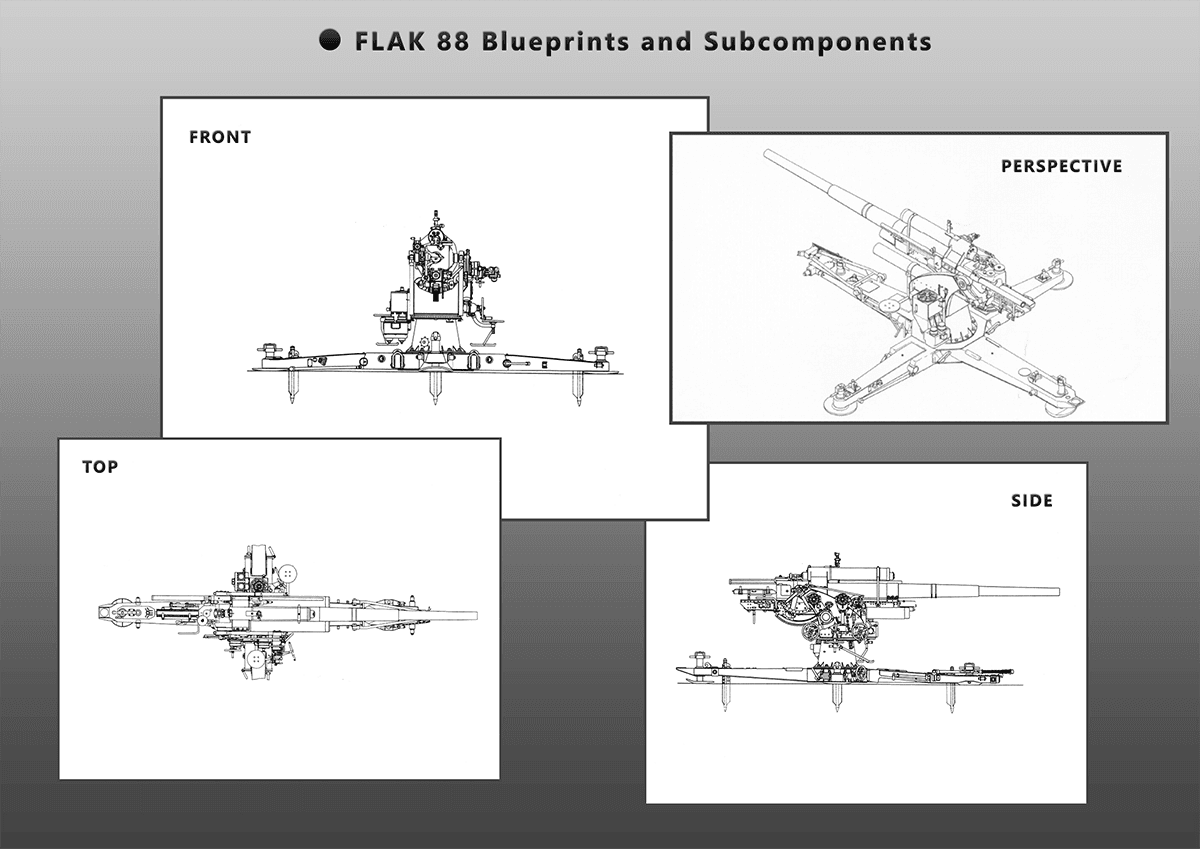
Flak 88 blueprint
3D High Poly Modelling

The first rule in modeling a high detail model is to create as many components as you need. Never try to create the whole model from one element. The Flak 88 model has over 300 components each a unique 3d mesh. Because the high poly model was intended for game usage the interior components have not been modelled. An example will be the rifling of the gun barrel (the process making helical grooves in the barrel of a gun or firearm, which imparts a spin to a projectile around its long axis).

Each component is modelled from a standard primitive and chamber and inset modifiers are used to give a smooth look. Some of the components have been made with the help of splines, but 90% of the models are from editable polygons. The process is not a very complex one if you have a clean workflow and the scene is well organized in groups and layers.

Once all of the components have been created, the next step is to group them for the low poly model topology and map extraction.  One important aspect is that depending on the low poly model complexity and maximum poly count, we can group the high poly model to add or exclude details from the game ready asset. For our purpose the ~2000 polygons model will have less details than a PC model that will have between 8000-15000 polygons. The best think is that with a high definition model we have the top asset and from there we can downgrade for mobile, pc, or console assets with ease.
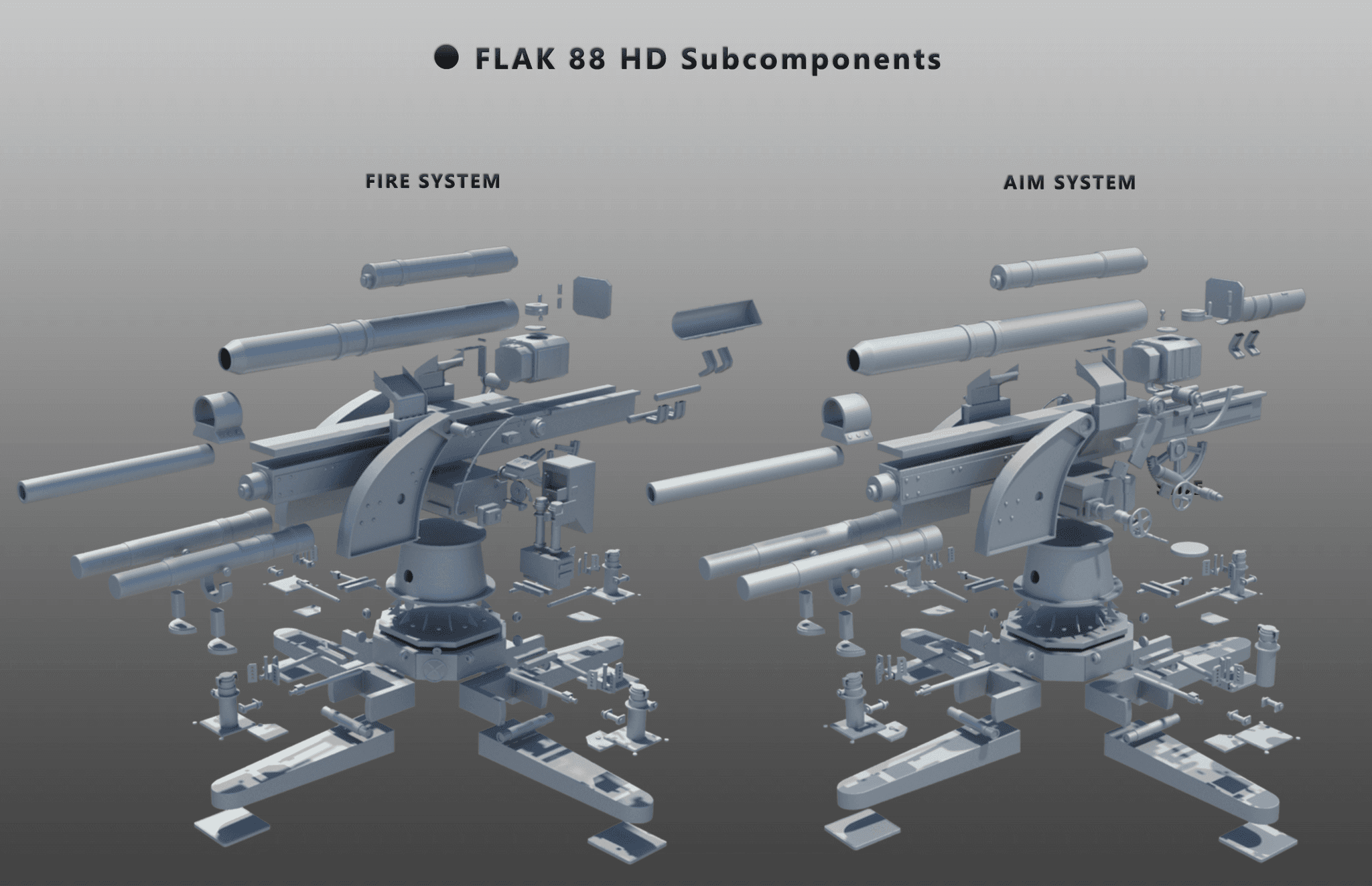
Flak 88 HD Subcomponents
Retopology of low poly model

As with the soldier mesh, we create a low poly model on top of the high poly model, but in this case our mesh will not be a one on one retopology. In other words we will create a low poly component from a group of high detail components. To better understand the level of detail that was extracted from the high poly model we can view the low poly model subcomponents with normal map and a wireframe.

 All five core systems from the high poly model have been preserved but most of the “detail” subcomponents have been integrated in the normal map. As in the previous presentation, the normal map is a key component in the developing process of a game ready asset and in this presentation we will explain in more detail the purpose and how to create a normal map.    
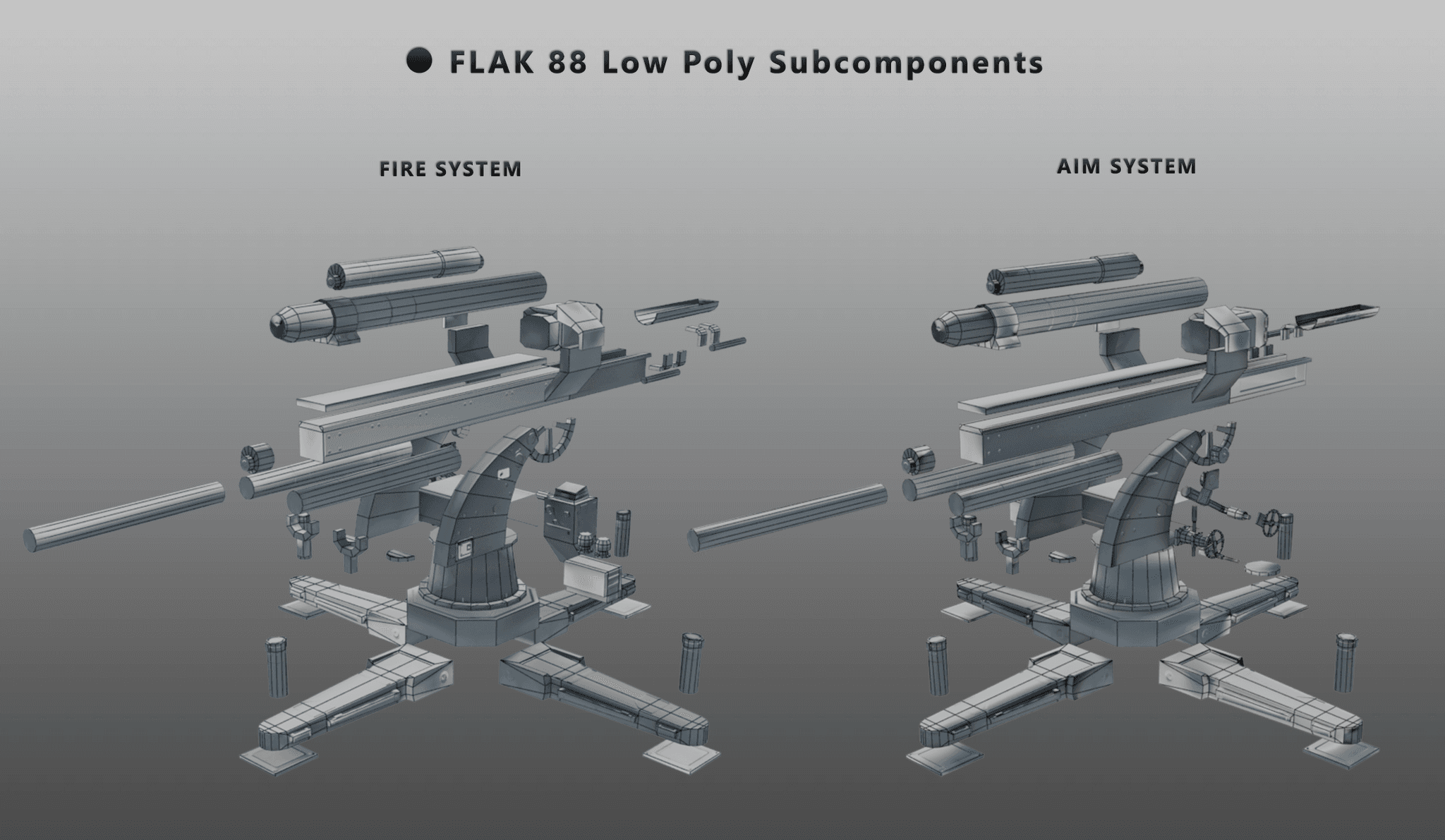
Low poly Subcomponents

Normal mapping is a technique used for faking the lighting of bumps and dents and add details to a model without using extra polygons. It tells the engine how to display the light hitting the object.  

Current hardware can only handle a certain number of polygons still, but normal maps give us more detail without actually stressing the processors as much as trying to render the high poly models that the normal map comes from.

For creating a good normal map you need to take the fallowing steps:

  • match the low poly model to the low poly model (retopology)
  • everything must have a unique UV space(creating mirroring and flipping is allowed and the engine can just use the facing direction of the UVW chunks)
  • have as few seams as possible and hide them in in non-visible arias.
  • setup the cage(without a cage all the rays cast in the bake will travel the same distance)
  • try to have the cage as close as possible to the high poly model
  • tweak and clean the normal map in Photoshop by using the RGB channels to paint and/or repair the map
  • a good trick is to render the base normal map at a higher resolution than the ingame map( usually at 2 or even 4k for extracting detail from a 5-10 million polygon model)
Rigging the low poly model

Rigging is the term used for creating links, joints, connections, wire parameters or constrains so that you can animate a 3d model. At the same time this terminology isn’t used only for animating characters that have a biped skeleton structure. From a handgun, car, robotic arm, head and so on, everything can be rigged, but depending on the model different techniques will be used.

In our case, I used 3 rigging methods to create the fire, reload and rotation animations for ingame usage.  The first step was to modify the position of the pivots for the subcomponents so that they would move, or rotate from a specific center position.

The next step was to create a link constraint between the subcomponents. These acts like a physical connection tree that makes the child subcomponents move/rotate after their parents.

Once this was done, I wired the parameters of the two rotation wheels with the FlaK 88 vertical and horizontal rotation subcompoments. Wire Parameters lets you link any two object parameters in the viewport, so that adjusting one parameter changes the other automatically. This enables you to set up one- and two-way connections between specified object parameter. In our case I wrote a simple expression: Rotation: Euler XYZ: Y Rotation: Float Wire= Euler XYZ: Y Rotation*1/12: Float Wire.

For the horizontal rotation I used the same expression only that I changed the y axis with x one and the ratio was one on one.

The final step was to connect the soldier hands and animate them when they rotate the wheels. For this I first positioned the hands over the wheels and then used the Inverse Kinematics (IK) to link them to the wheels. Inverse kinematics (IK) uses a goal-directed method, where you position a goal object and 3ds Max calculates the position and orientation of the end of the chain. This is why, IK requires greater thought about how to link the objects and place the pivots.

Animating the low poly model

Once the rigging is complete, animating the Flak 88 is quite a simple process that requires dividing the animation in three subcomponents (shoot, reload, soldier hands movement) and creating a loop. To achieve the shoot and reload animation, I studied actual movie clips from WW2 and then animated each subcomponent on a time line with different spline types (linear, smooth fast, slow or custom made). This splines show the evolution of a transform (move, rotate on XYZ axis) in a time interval and by modifying the curve we can achieve effects like acceleration, deceleration, full stop and so on. 

In creating animations there isn’t a hardcoded rule in how many frames, or what kind of splines to use. The best way to test if your animation is good is to compare it with real life footage if you have that resource available. Another way is to play the animation at half speed and/or play it backward.

 A good animation is an animation that doesn’t pop out and no matter where u pause it and when you resume, it feels as natural as playing the complete clip.   
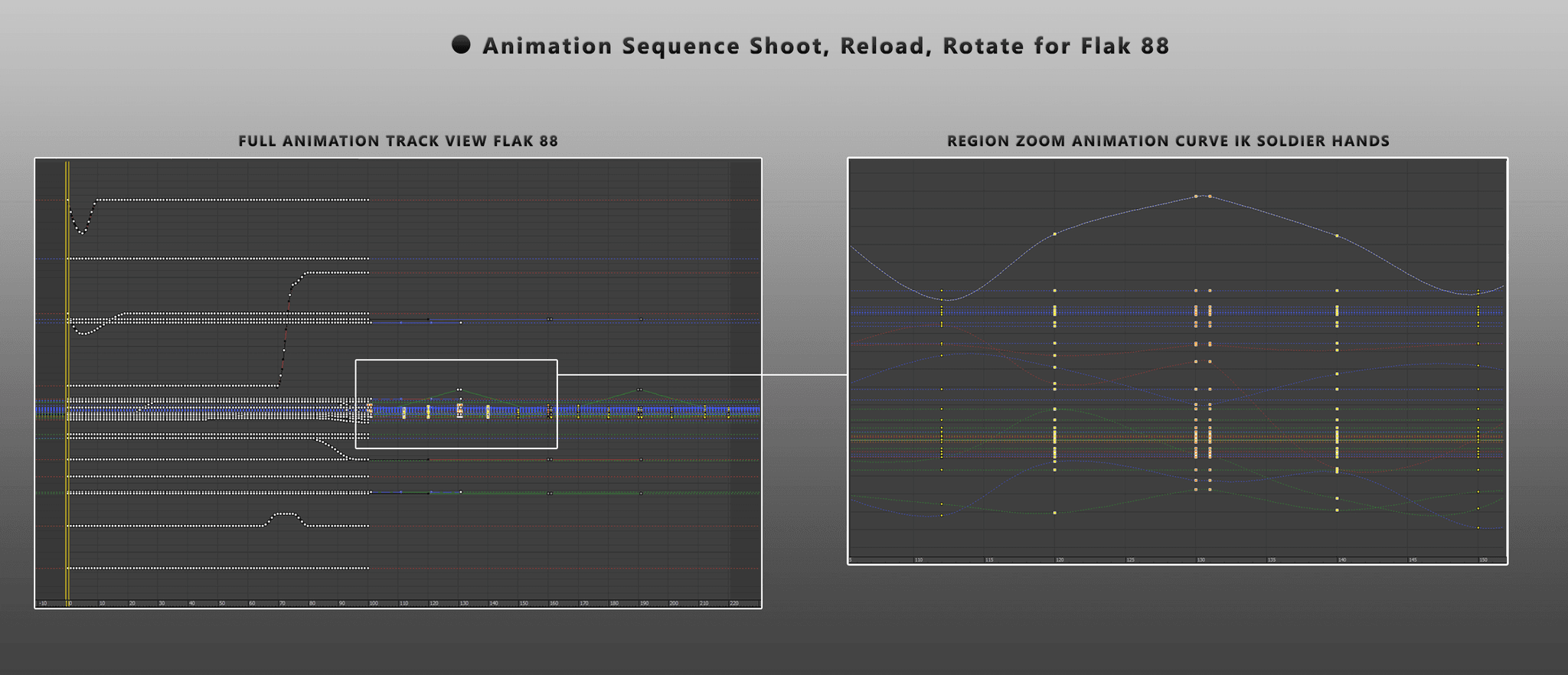
Flak animation sequence
Conclusion

The main purpose of this presentation was to continue explaining the process behind developing game ready assets for mobile platforms started in the previous blog entry (The Pipeline Behind Modeling and Animating a Game Character in Zelgor).  At the same time, core components like normal map creation and rigging have been explained in a higher detail and new components unique for this asset have been introduced.

Another aspect introduced, was the process of using game assets previous build (World War 2 marine) and integrating them in the new pipeline. As we further move along, new components will be presented and old ones will be better explained. At the same time I will try to slowly enter the game engine and see how we use our assets for the final stage in game developing. 

Uptate: Please read my last articole too, it's called: Mechanical Rigging - Dreadnought Animation Setup

→ If you want to find out more about the author of the article click play on the below video.
Share on:

I have read and understood the ASSIST Software website's Terms of Use and Privacy Policy.

Want to stay on top of everything?

Get updates on industry developments and the software solutions we can now create for a smooth digital transformation.

Frequently Asked Questions

1. Can you integrate AI into an existing software product?

Absolutely. Our team can assess your current system and recommend how artificial intelligence features, such as automation, recommendation engines, or predictive analytics, can be integrated effectively. Whether it's enhancing user experience or streamlining operations, we ensure AI is added where it delivers real value without disrupting your core functionality.

2. What types of AI projects has ASSIST Software delivered?

We’ve developed AI solutions across industries, from natural language processing in customer support platforms to computer vision in manufacturing and agriculture. Our expertise spans recommendation systems, intelligent automation, predictive analytics, and custom machine learning models tailored to specific business needs.

3. What is ASSIST Software's development process?  

The Software Development Life Cycle (SDLC) we employ defines the stages for a software project. Our SDLC phases include planning, requirement gathering, product design, development, testing, deployment, and maintenance.

4. What software development methodology does ASSIST Software use?  

ASSIST Software primarily leverages Agile principles for flexibility and adaptability. This means we break down projects into smaller, manageable sprints, allowing continuous feedback and iteration throughout the development cycle. We also incorporate elements from other methodologies to increase efficiency as needed. For example, we use Scrum for project roles and collaboration, and Kanban boards to see workflow and manage tasks. As per the Waterfall approach, we emphasize precise planning and documentation during the initial stages.

5. I'm considering a custom application. Should I focus on a desktop, mobile or web app?  

We can offer software consultancy services to determine the type of software you need based on your specific requirements. Please explore what type of app development would suit your custom build product.   

  • A web application runs on a web browser and is accessible from any device with an internet connection. (e.g., online store, social media platform)   
  • Mobile app developers design applications mainly for smartphones and tablets, such as games and productivity tools. However, they can be extended to other devices, such as smartwatches.    
  • Desktop applications are installed directly on a computer (e.g., photo editing software, word processors).   
  • Enterprise software manages complex business functions within an organization (e.g., Customer Relationship Management (CRM), Enterprise Resource Planning (ERP)).

6. My software product is complex. Are you familiar with the Scaled Agile methodology?

We have been in the software engineering industry for 30 years. During this time, we have worked on bespoke software that needed creative thinking, innovation, and customized solutions. 

Scaled Agile refers to frameworks and practices that help large organizations adopt Agile methodologies. Traditional Agile is designed for small, self-organizing teams. Scaled Agile addresses the challenges of implementing Agile across multiple teams working on complex projects.  

SAFe provides a structured approach for aligning teams, coordinating work, and delivering value at scale. It focuses on collaboration, communication, and continuous delivery for optimal custom software development services. 

7. How do I choose the best collaboration model with ASSIST Software?  

We offer flexible models. Think about your project and see which model would be right for you.   

  • Dedicated Team: Ideal for complex, long-term projects requiring high continuity and collaboration.   
  • Team Augmentation: Perfect for short-term projects or existing teams needing additional expertise.   
  • Project-Based Model: Best for well-defined projects with clear deliverables and a fixed budget.   

Contact us to discuss the advantages and disadvantages of each model. 

1. Is ASSIST Software a reliable company for custom engineering?

Absolutely. Our partners have given us great recommendations and reviews, leading us to win The Manifest Award for Most Reviewed Software Developers. Further proof comes from our 97% employee retention rate and ongoing client partnerships for over 8 years.  

2. Are the ASSIST Software Romanian software engineers certified?

Yes. 85% of our software programmers are certified.  

At a company level, ASSIST Software is certified and recognized by industry players such as Microsoft, AWS, Google Cloud, Adobe, Drupal, Fujitsu, ISTQB, and others.  

Our employee certifications are tremendously important as they reflect the shared commitment to long-term growth.

3. Why should I choose Romania for custom software development? 

Romania has become a significant player in custom software development, attracting businesses worldwide. Romania boasts the highest number of certified IT specialists in Europe and ranks sixth globally, surpassing even the US in tech specialists per capita.  

At ASSIST Software, what sets us apart is our team and our location: our engineers are certified, experienced, and flexible, while being in the +2 GMT time zone allows us to easily facilitate meetings with clients all over the world.

4. What team will work on my project, and where will it be located?

ASSIST Software's headquarters is in Romania, a prime country for software development outsourcing. Our 350+ software engineers speak English and have a deep passion for innovation.  

We provide regular project updates through reports, meetings, and online dashboards. Generally, you'll have access to a dedicated project manager who will be your point of contact for any questions or concerns.  

5. How much will my project cost me?

Our prices are competitive, and as per our working model, we guarantee you will be satisfied with the result. Frequent meetings, check-ins, and a great communication structure will ensure this outcome.   

Project costs depend on various factors, including complexity, scope, required technologies, and team size. We'll gather detailed information about your project during the initial consultation to provide a customized quote and we guarantee that you will be able to see the benefits of bespoke software.  

1. What technologies do you work with?

ASSIST Software tackles your projects with a robust tech stack. We build native and cross-platform mobile apps, craft user-friendly web experiences, and create stunning visuals. 

Our wide-ranging expertise starts from Java, Python, and JavaScript frameworks to cutting-edge solutions like AR/VR, blockchain, and AI/ML. We also manage databases, leverage cloud platforms, and ensure flawless project execution. We're your one-stop shop for exceptional software development from concept to deployment. You can view our expertise for more details.   

2. Are you experienced in AI/ML development?

Yes. We have extensive experience in data engineering and machine learning operations (MLOps). We can employ neural networks, computer vision, and AI models to benefit your ideas.   

You can trust our long-term experience with big data, NLP, and sentiment analysis, as over the past three years, we led a European security project with 15 partners focused on detecting radicalization on social media and the dark web.

3. Do you have a research and development department and work on European Projects?

We know R&D is crucial for businesses to stay competitive and thrive in dynamic markets. Successful R&D efforts lead to developing exceptional products or services, improved efficiency and effectiveness in operations, and enhanced market positioning.   

We have established solid partnerships with 160+ European research companies, universities, and research centers (e.g., Fraunhofer, TWI, University of Heidelberg, REWE Group, SINTEF, etc.) and have participated as technical partners in over 25 EU-funded projects.  

4. Besides custom software solutions, what other services do you offer?

  • Design Thinking for Breakthrough Products:  

    We craft user experiences that resonate. Our design process is an immersive collaboration, starting with workshops to uncover your vision and user needs. We conduct market research, analyze the competition, and guide you toward cutting-edge solutions in accordance with your business requirements.  

  • Digital Transformation to Reimagine Your Business:

    Digital transformation is nothing less than a strategic shift. We empower you to become more agile and data-driven, optimizing core processes for the digital age.  

  • Scale with Confidence as We Build for Growth:  

    We understand that business success and development mean new challenges. Our solutions are built to scale seamlessly, accommodating increasing user bases and data volumes without sacrificing performance or security.  

5. As a company, does ASSIST have its own software products?

Yes, ASSIST Software teams have been involved in designing and developing innovative products that address community needs. One such example is the web and mobile platform Autisma. This therapy assistant enables continued learning for children diagnosed with autism spectrum disorder.   

Our extensive knowledge of the Unity and Unreal engines has allowed us to develop two mobile games, Elly and the Ruby Atlas and Hooman Invaders, as well as various Unity Assets, such as the Real-Time Weather PRO and Easy Sky. These two Unity assets allow Unity developers to control the weather and sky in their projects.   

1. Is ASSIST Software hiring right now?

We are always looking for great people to join our team, whether you're a senior software engineer or a new talent seeking an IT career. Please check our careers page and contact us. Our HR department will contact you as soon as possible.   

2. Is ASSIST Software organizing internships?

Yes. Each year, we organize individual and group internships for students. Our long-term partnership with the Stefan cel Mare University of Suceava allows us to put together great events for students and help them get started in the industry. 

3. What type of learning culture does ASSIST Software encourage?

Our focus on innovation comes from a 'can do' attitude and the continuous learning we encourage our colleagues to pursue. We frequently organize workshops, learning sessions, presentations, and masterclasses. All these events are free and open to our colleagues and aim to support their professional and personal development. 

4. How does ASSIST Software focus on teamwork?

The key to stellar teamwork is the quality time we spend together. ASSIST employees and their families are frequently invited to participate in all activities. We encourage a healthy lifestyle by promoting and organizing hikes, bike riding sessions, marathons, volleyball, football and tennis matches, ping-pong championships, and many more.   

We show our care for the environment through reforestation campaigns and forest cleaning activities.   

We also have an English-speaking club, e-sports gaming nights, tech discussions, networking parties, and board game sessions.   

5. How does ASSIST Software give back to the community?

Volunteering and charity are essential to us, which is why we founded the ASSIST Humanitarian Foundation. We genuinely care about our community and want to improve the future. We invest in IT equipment for schools and award excellent teachers. We also help hospitals and fire departments enter the 21st century.   

We sponsor cultural events and deliver humanitarian aid to those in need. If you agree with our views, you can also donate.   

ASSIST Software Team Members