Strategic Roadmap for European Cyber Resilience Defined at LLM4CIP General Assembly in Athens
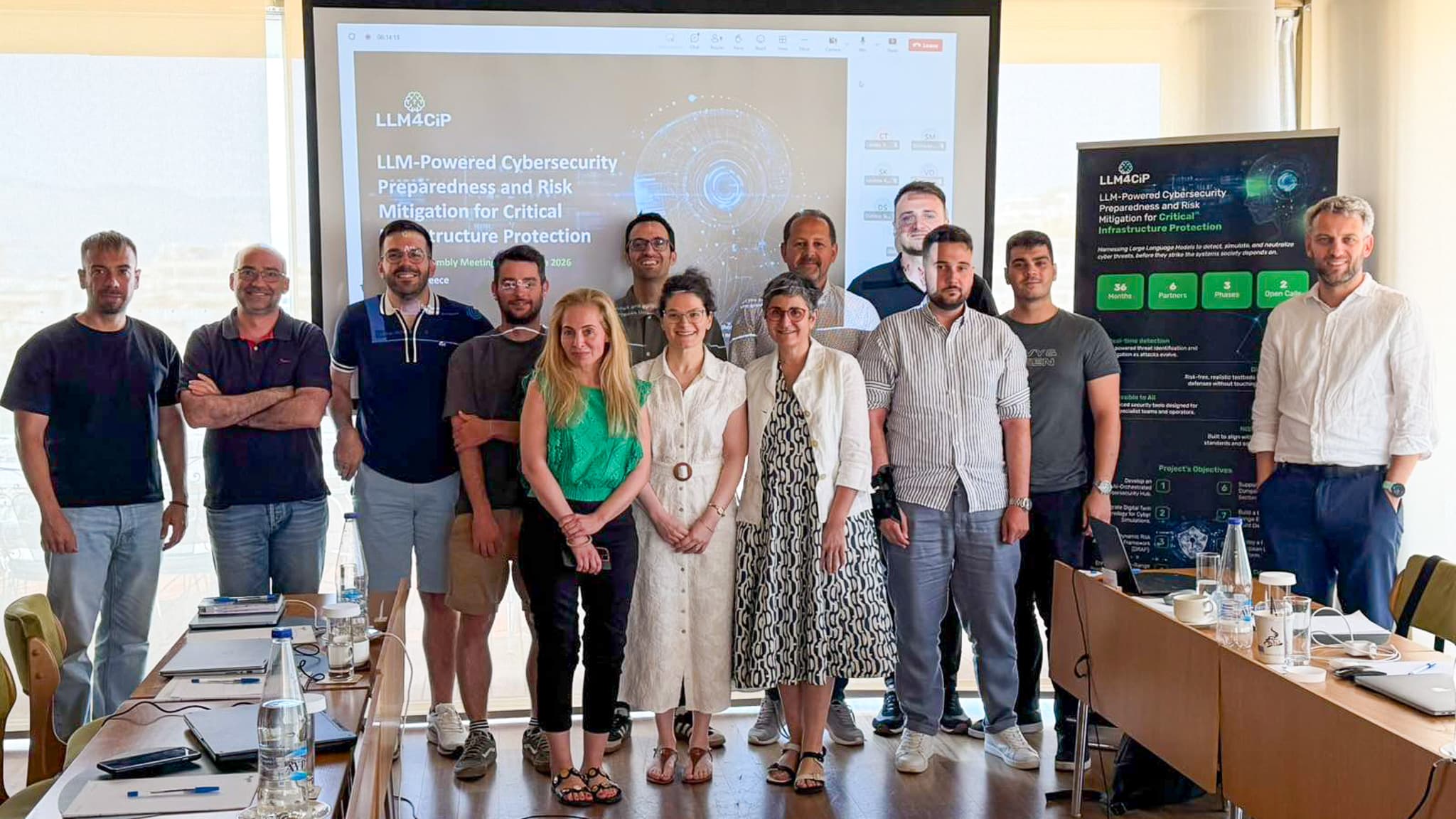
Six months after its official launch, the ambitious Horizon Europe project LLM4CIP – Large Language Model‑Powered Cybersecurity Preparedness and Risk Mitigation for Critical Infrastructure Protection – reached its first major implementation milestone. Following a highly successful kick-off in Romania earlier this year, the international consortium gathered in Athens, Greece, on June 22-23, 2026, for its 1st General Assembly. Hosted by UBITECH, the two-day event marked the project's transition from foundational strategy and requirement gathering to active platform implementation and technical development in the upcoming period.
From Vision to Blueprint: Building the LLM4CIP Technical Core
By merging European LLMs with Cyber Digital Twin technology, LLM4CIP is actively replacing legacy, reactive defenses with an AI-orchestrated cybersecurity hub that simulates complex attack vectors and automates compliance with the strict NIS2 Directive. Transitioning this vision into an actionable reality was the central focus of the assembly's opening day.
Led by Project Coordinator Cătălin Trufin on behalf of ASSIST Software, the consortium kicked off Day 1 by reviewing the project's financial and technical progress over its first six months. With the foundational objectives validated, the remaining sessions focused on mapping the upcoming platform implementation and solidifying the operational framework for the Open Calls planned for the second year of the project.
Bringing the system's core design into focus, Vlad Dediță, Software Architect at ASSIST Software, mapped out the platform’s core architecture. As LLM4CIP transitions from strategy to active engineering, technical partners (ASSIST, UBITECH, and ICSS) outlined the integration strategy required to deploy secure, locally hosted European AI models within a robust cloud-native environment. By prioritizing data sovereignty and secure container pipelines, this architectural framework ensures that sensitive critical infrastructure data remains highly localized and fully protected.
Driving Real-World Adoption
LLM4CIP is designed to achieve a profound, far-reaching impact on European critical infrastructure within the project’s lifetime. This will be achieved by actively enabling – and financially supporting – the deployment of its advanced cybersecurity solutions across approximately 42 operators from vital industrial sectors, directly strengthening their operational defenses. More than half of the entire project budget – 2.5 mil EUR – has been strategically allocated directly to funding these early adopters. Managed by the European Digital SME Alliance, this funding will be distributed across two highly anticipated rounds of Open Calls launching in January and September 2027.
By deploying the platform directly into active, complex industrial environments, their high-level operational feedback will provide invaluable, real-world data. This collaborative insight will allow the consortium to further enhance, fine-tune, and optimize the cybersecurity solutions during the final phase of the project, ensuring the technology is completely hardened and market-ready.
Maximizing Impact: Governance, Global Visibility, and Project Quality
The second day of the General Assembly shifted the focus to long-term operational sustainability, project quality, rigorous risk management, and IPR considerations. Under the guidance of EBOS, the partner responsible for quality assurance, the consortium evaluated current progress on data management and quality control strategies, ensuring that all data handling protocols remain strictly aligned with European compliance frameworks. A major portion of the day was dedicated to assessing dissemination strategies and tracking key performance indicators (KPIs) to maximize the project's visibility and impact across Europe's cybersecurity community. Through consistent dissemination efforts, the LLM4CIP consortium has secured significant international visibility, driven by the strategic coordination of eBOS as the project’s dissemination and exploitation leader.
Protecting Innovation: Commercial Readiness and Regulatory Compliance
As this expanding international presence positions LLM4CIP as a benchmark for European infrastructure safety, ensuring the long-term protection and legal integrity of these breakthrough solutions becomes the next vital step. To this end, the consortium officially began mapping the project's Intellectual Property Rights (IPR) framework and establishing a patent assessment process to protect the partners' proprietary AI tools and automated pipelines.
All overarching legal, regulatory, and ethical dimensions are overseen by EUNOMIA, the project's dedicated legal framework partner. By closely monitoring compliance with European privacy standards, cross-border data sovereignty laws, and the complex requirements of the EU AI Act, EUNOMIA's structural oversight guarantees that LLM4CIP's architectural advancements remain legally sound and ready for commercial deployment within heavily regulated industrial markets.
Funding and Support
LLM4CIP is funded by the DIGITAL Europe Program of the European Union and submitted under the DIGITAL-ECCC-2024-DEPLOY-CYBER-07-LARGEOPER call for proposals, with project ID 101249717.