Future Intelligence Think Tank Surpasses 1,000 Members

Date published: September 23, 2026
3 min read

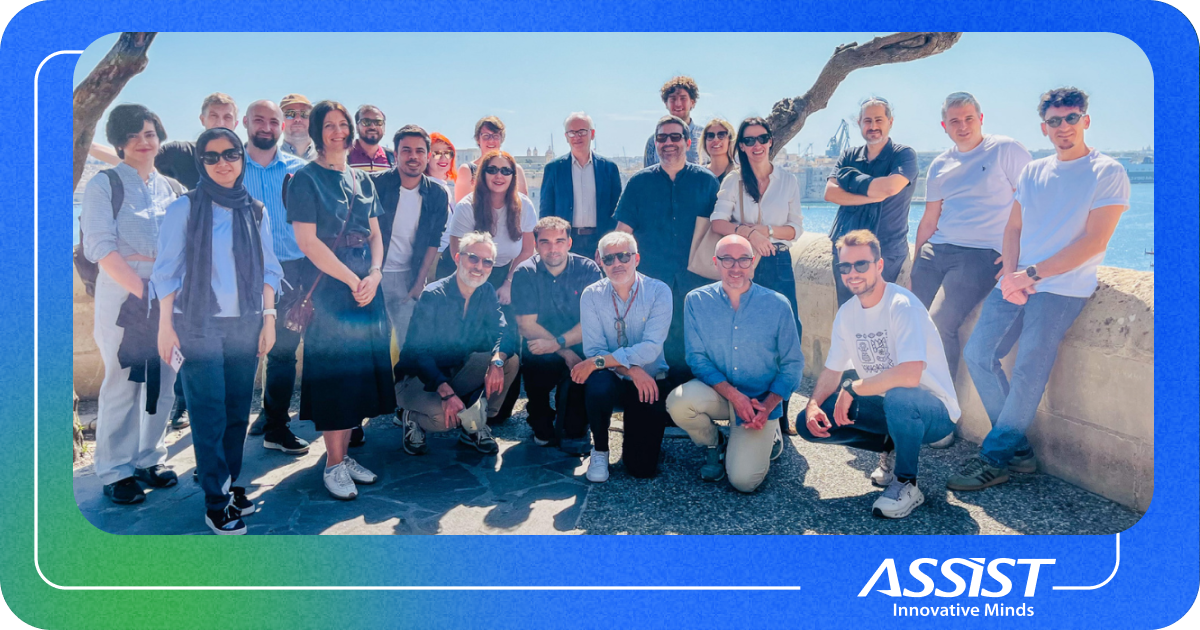
The Future Intelligence Think Tank crossed 1,000 members in September 2026. More than two-thirds of participants come from outside ASSIST Software, representing companies, universities, research institutions, and professional fields that rarely share a forum. Engineers alongside ethicists, founders alongside educators, clinicians alongside technologists, that mix is what makes the conversations worth having. 

What the conversations look like

The subjects attracting the most sustained attention are not always the ones that dominate technology headlines. Members have spent significant time on questions that sit at the edge of what AI can and cannot do: how professional judgment changes when people supervise AI-generated work rather than produce their own, what physical and financial constraints actually underlie the rapid expansion of AI infrastructure, and which decisions need to be made before autonomous systems operate without reliable human oversight.

Other discussions have moved into territory that a purely technical community might not explore, such as organizational knowledge and how it degrades, authorship and creativity in an AI-assisted environment, and the humanitarian implications of decisions being made now about systems that will operate for decades.

Engineers and specialists from ASSIST Software participate in these discussions alongside members from other organizations, bringing experience from AI development and deployment into conversations that benefit from that grounding. The result tends to be exchanges where practical constraints and broader implications inform each other, rather than running in parallel. 

Think Tank ASSIST Software

A community extending beyond LinkedIn

Since the first milestone article, the community has continued to develop outside the LinkedIn group itself. Longer perspectives are published through Medium and Substack, where selected discussions are explored in greater depth. The Future Intelligence Think Tank website brings together featured conversations, community information, and ways to participate. Faculty members at Ștefan cel Mare University of Suceava have featured the community with their academic audiences, extending its reach into research and education.

The questions the community is working through do not fit neatly into a LinkedIn format. How organizations make decisions under uncertainty, how expertise changes when AI is involved, what responsible deployment actually requires, these are subjects that benefit from longer form and more varied contexts than a group post allows. 

What a mixed community makes possible

The same development in AI can look entirely different depending on where you encounter it. A researcher assessing the evidence, an engineer making implementation decisions, and a business leader deciding whether and how to deploy a system are often looking at the same technology through incompatible frames of reference. A community that brings those frames into contact does something that a homogeneous group cannot.

That is what the Future Intelligence Think Tank has been working toward since its founding. The number matters less than what produced it, a sustained interest in questions that don't have easy answers, from people who encounter them from genuinely different positions. Whether the community continues to be worth participating in will depend on whether those conversations stay that way.

If these are the kinds of questions you work with, the Future Intelligence Think Tank is open to you. Join the conversation on LinkedIn.
Think Tank ASSIST Softare

Share on:

I have read and understood the ASSIST Software website's Terms of Use and Privacy Policy.

Want to stay on top of everything?

Get updates on industry developments and the software solutions we can now create for a smooth digital transformation.

Frequently Asked Questions

1. Can you integrate AI into an existing software product?

Absolutely. Our team can assess your current system and recommend how artificial intelligence features, such as automation, recommendation engines, or predictive analytics, can be integrated effectively. Whether it's enhancing user experience or streamlining operations, we ensure AI is added where it delivers real value without disrupting your core functionality.

2. What types of AI projects has ASSIST Software delivered?

We’ve developed AI solutions across industries, from natural language processing in customer support platforms to computer vision in manufacturing and agriculture. Our expertise spans recommendation systems, intelligent automation, predictive analytics, and custom machine learning models tailored to specific business needs.

3. What is ASSIST Software's development process?  

The Software Development Life Cycle (SDLC) we employ defines the stages for a software project. Our SDLC phases include planning, requirement gathering, product design, development, testing, deployment, and maintenance.

4. What software development methodology does ASSIST Software use?  

ASSIST Software primarily leverages Agile principles for flexibility and adaptability. This means we break down projects into smaller, manageable sprints, allowing continuous feedback and iteration throughout the development cycle. We also incorporate elements from other methodologies to increase efficiency as needed. For example, we use Scrum for project roles and collaboration, and Kanban boards to see workflow and manage tasks. As per the Waterfall approach, we emphasize precise planning and documentation during the initial stages.

5. I'm considering a custom application. Should I focus on a desktop, mobile or web app?  

We can offer software consultancy services to determine the type of software you need based on your specific requirements. Please explore what type of app development would suit your custom build product.   

  • A web application runs on a web browser and is accessible from any device with an internet connection. (e.g., online store, social media platform)   
  • Mobile app developers design applications mainly for smartphones and tablets, such as games and productivity tools. However, they can be extended to other devices, such as smartwatches.    
  • Desktop applications are installed directly on a computer (e.g., photo editing software, word processors).   
  • Enterprise software manages complex business functions within an organization (e.g., Customer Relationship Management (CRM), Enterprise Resource Planning (ERP)).

6. My software product is complex. Are you familiar with the Scaled Agile methodology?

We have been in the software engineering industry for 30 years. During this time, we have worked on bespoke software that needed creative thinking, innovation, and customized solutions. 

Scaled Agile refers to frameworks and practices that help large organizations adopt Agile methodologies. Traditional Agile is designed for small, self-organizing teams. Scaled Agile addresses the challenges of implementing Agile across multiple teams working on complex projects.  

SAFe provides a structured approach for aligning teams, coordinating work, and delivering value at scale. It focuses on collaboration, communication, and continuous delivery for optimal custom software development services. 

7. How do I choose the best collaboration model with ASSIST Software?  

We offer flexible models. Think about your project and see which model would be right for you.   

  • Dedicated Team: Ideal for complex, long-term projects requiring high continuity and collaboration.   
  • Team Augmentation: Perfect for short-term projects or existing teams needing additional expertise.   
  • Project-Based Model: Best for well-defined projects with clear deliverables and a fixed budget.   

Contact us to discuss the advantages and disadvantages of each model. 

ASSIST Software Team Members