COMPLIANCE4DPP Project Officially Launched to Automate Digital Product Passports
What if compliance wasn't a burden, but a business enabler?
As Europe moves toward a circular economy, manufacturers face an immediate and massive challenge: how do we make increasingly complex regulatory requirements manageable, scalable, and trustworthy? With the EU’s Circular Economy Action Plan targeting a doubling of material recycling and reuse rates by 2030, the arrival of Digital Product Passports (DPPs) is moving fast.
Too often, compliance is treated as a complex, siloed, box-ticking exercise that threatens to drown companies, especially Small and Medium-sized Enterprises (SMEs), in administrative paperwork.
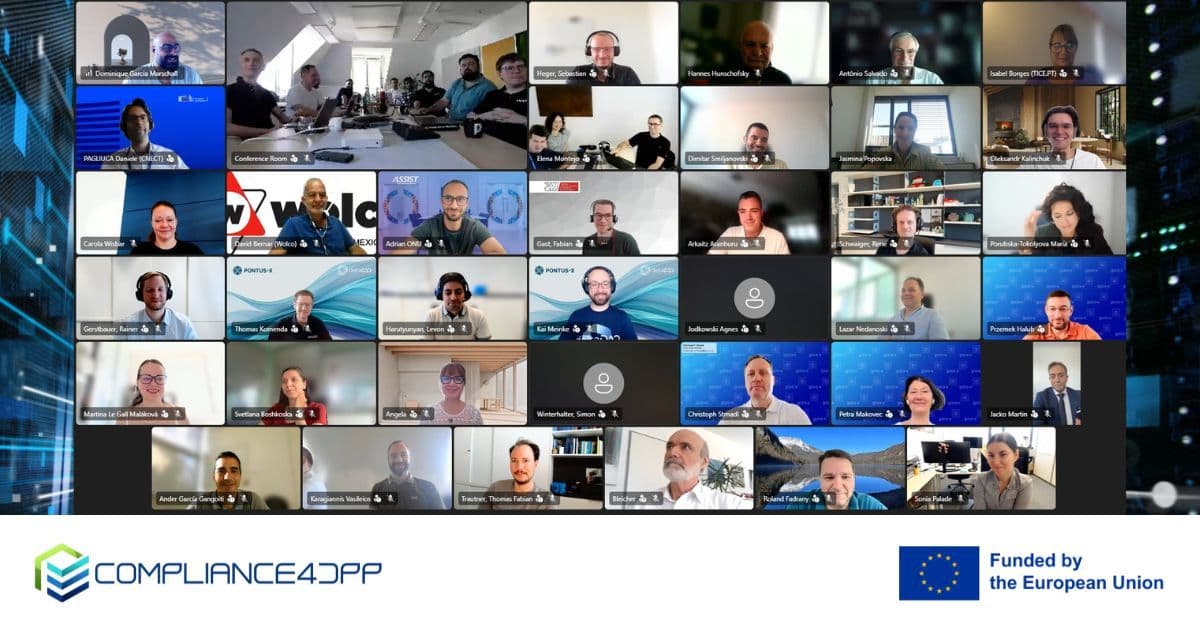
COMPLIANCE4DPP is here to change that narrative. Officially launched on June 1, 2026, the consortium successfully held its online project Kick-Off meeting on June 24, 2026, under the coordination of EIT Manufacturing East. Funded by the European Union under the Horizon Europe program, this ambitious three-year initiative brings together 19 leading partners from nine countries. The virtual session served to align this multi-stakeholder ecosystem around its mission to transform DPP data compliance from an operational cost center into a powerful driver of digital competitiveness and innovation, and to establish the immediate technical and strategic roadmaps for the work ahead.
What COMPLIANCE4DPP is building and why it matters for European manufacturers
Coordinated by EIT Manufacturing East GmbH, COMPLIANCE4DPP will build the open-source infrastructure needed to automate compliance verification. By embedding "Compliance-as-Code" (executable software logic) directly into existing European data spaces – specifically leveraging the Gaia-X Trust Framework and the Pontus-X Lighthouse Data Space – the project will enable seamless, secure, and sovereign cross-border data transactions.
The project's automated tools are designed to fully comply with strict EU frameworks, including the GDPR, the AI Act, the Data Governance Act, and the Data Act, while actively lowering the risk by driving core software components to a highly mature Technology Readiness Level 8 (TRL 8), ready for real-world production.
ASSIST Software's role in the project
As a technical partner and system integrator, ASSIST Software SRL is playing a pivotal role in transforming COMPLIANCE4DPP’s high-level vision into actionable digital infrastructure.
ASSIST Software is leading the engineering of the Compliance Service Kit, the project's core integration-driven technology stack. This initiative serves as the single point of enforcement for automated regulatory checks by consolidating standalone policy engines, industrial use-case requirements, and regulatory frameworks into a unified system.
To bridge the gap between technical complexity and real-world deployment, ASSIST's contributions focus on:
- Participating in the core engineering of tools that translate complex natural-language legal requirements (such as the GDPR, Data Act, and AI Act) into machine-executable blocks of code.
- Consolidating standalone software modules – such as policy generation tools and decision engines – into a cohesive, enterprise-grade application programming interface (API) and a lightweight administrative user interface (UI).
- Ensuring the resulting compliance toolkit is optimized to run smoothly within sovereign European data spaces (such as the Pontus-X network and the Gaia-X framework) and aligns with standardized digital twin models.
- Contributing technical expertise to project business models and Intellectual Property Rights (IPR) registries to ensure these open-source tools can be sustainably commercialized and adopted by European industry long after the project concludes.
The roadmap from kick-off to production-ready infrastructure
The successful June kick-off meeting has set a clear trajectory for the next three years. COMPLIANCE4DPP is uniquely positioned to empower European manufacturers to build cleaner supply chains, secure sovereign data networks, and turn trust into a tangible asset. Building on this initial momentum, the consortium will reunite in November 2026 for its first in-person General Assembly in Vienna, Austria, where partners will align on the project's first foundational technical blueprints.
Funding and Support
Compliance4DPP - Fostering Resilient and Auto-Compliant Manufacturing ValueChains through Advanced Digital Product Passports and Interoperable Data Ecosystems for a Circular Economy, is a project funded under Horizon Europe - HORIZON-CL4-2025-03-DATA-13: Fostering Innovative and Compliant Data Ecosystems (IA) (AI, Data and Robotics Partnership), with Grant Agreement ID number 101298718.