AI-Assisted QA: How Automation Is Changing the Role of Software Testers
Artificial intelligence is reshaping the way software teams approach quality assurance. Tools that can analyze requirements, suggest test scenarios, identify regression risks, and detect defect patterns are no longer experimental. They are becoming part of the everyday QA workflow.
This shift is not removing the need for QA specialists. Instead, it is changing where their value sits within the software development process.
As AI takes over more repetitive and systematic testing tasks, QA professionals are moving closer to product strategy, risk analysis, user experience, and business-critical decision-making. The future of quality assurance is not fully automated. It is AI-assisted, human-led, and increasingly strategic.
What AI-assisted QA can do
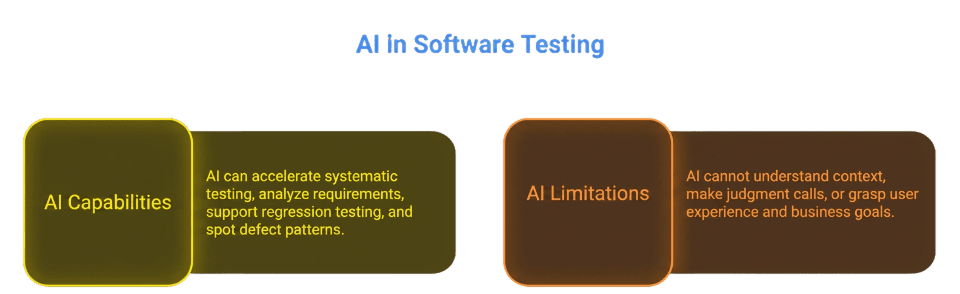
AI can bring significant value to structured, repeatable, and data-driven testing.
It can analyze product requirements and suggest relevant test scenarios faster than a manual review. It can support regression testing by identifying code areas that may be affected by a recent change. It can help teams detect recurring defect patterns and surface quality risks that might otherwise take hours to identify manually.
For companies building complex digital products, this means faster feedback loops, improved test coverage, and earlier visibility into potential issues.
AI-assisted QA can also help reduce the manual effort required for repetitive checks, allowing QA teams to focus more on areas where human expertise adds the most value.
What AI cannot replace in quality assurance
While AI can accelerate testing, it cannot fully understand what quality means in a specific business context.
A feature can pass every predefined test case and still create friction for users. It can be technically correct but operationally confusing. It can comply with the specification, yet still fail to support the workflow it was designed for.
These are not simple automation problems. They are judgment calls.
Understanding whether a product truly works requires knowledge of the users, the business objectives, the product environment, and the risks associated with failure. This is where QA specialists remain essential.
Human testers can question assumptions, explore unexpected paths, evaluate usability, and identify issues that are not explicitly covered by requirements or test scripts. Their work is not limited to checking whether something functions. It involves assessing whether the product delivers value in real-world conditions.
Why the QA role is becoming more strategic
As AI handles more repetitive work, the role of QA is shifting from execution to analysis.
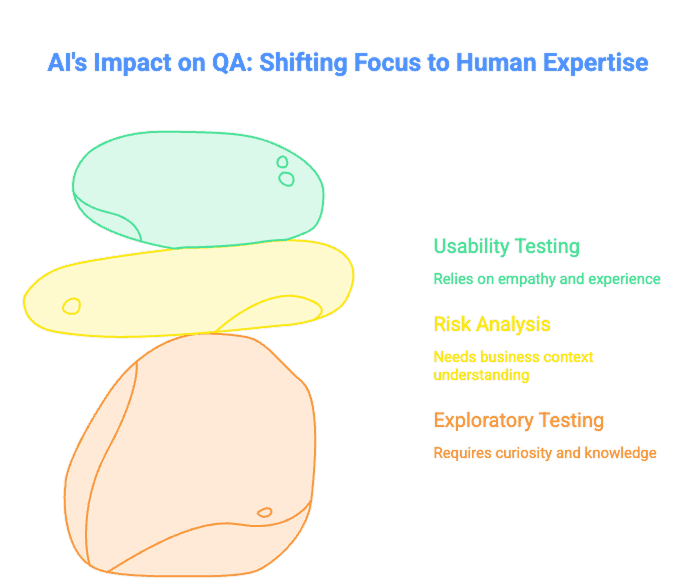
Exploratory testing is one example. Unlike scripted testing, exploratory testing depends on curiosity, product understanding, and the ability to investigate behavior that no predefined test case anticipated. It requires testers to think like users, challenge assumptions, and uncover problems that automation alone may miss.
Risk analysis is another area where human judgment is difficult to replicate. Deciding which parts of a system should be tested first, which failures would have the highest business impact, and where quality risks are most likely to appear requires more than technical information. It requires context.
The same applies to usability and user experience. Whether a product feels intuitive, supports the user’s mental model, and creates friction in critical workflows are observations rooted in empathy and experience.
This is why AI-assisted QA does not make testers less important. It makes their role more focused, more analytical, and more connected to business outcomes.
What this means for software development teams
For organizations, the rise of AI-assisted QA should not be seen only as a productivity improvement. It should be seen as an opportunity to rethink how quality is built into the development process.
The strongest software teams are not using AI to replace QA specialists. They are using it to remove repetitive work, improve visibility, and give QA teams more time to focus on complex decisions.
This requires a shift in mindset. QA should not be treated as a final verification step at the end of development. It should be integrated throughout the product lifecycle, with testers involved early in requirements analysis, risk assessment, product discussions, and release planning.
When QA becomes part of product thinking from the start, teams are better equipped to prevent defects rather than simply detect them.
At ASSIST Software, our experience building and maintaining complex digital products has shown that quality holds up best when QA is treated as a thinking discipline rather than just a testing function.
AI-assisted tools can speed up parts of the process, but they also raise the expectations placed on QA specialists. As repetitive tasks become easier to automate, testers are expected to contribute more through analysis, critical thinking, risk prioritization, and product understanding.
This evolution makes QA more valuable to software teams. It allows testers to focus on the questions that matter most: What could go wrong? What impact would it have? How would users experience it? Does the product truly solve the problem it was designed to solve?
Our colleague Alexandru Manolache explored this topic in his article, “Homo Digitalis: Why Testing Remains Human in the Age of Automation,” where he explains why critical thinking, empathy, and human perspective remain central to modern QA.

The part of QA that AI will not replace
AI-assisted QA is a genuine step forward for software development teams. It can improve coverage, create capacity, detect patterns, and surface issues earlier in the development process.
However, quality assurance is ultimately about more than finding defects. It is about assessing whether a product performs reliably, meets user needs, and delivers the intended business value.
That responsibility still requires human judgment.
As AI tools continue to evolve, the most successful teams will be the ones that understand the distinction between automation and quality. AI can support the testing process, but people still define what quality means.