MLOps in 2026: How Enterprises Build, Deploy, Monitor, and Scale AI
TL;DR
- MLOps is the discipline that transforms machine learning from a research exercise into a repeatable, scalable production process by applying automation, version control, monitoring, and continuous delivery to AI systems.
- Without MLOps, organizations often struggle to reproduce experiments, deploy models consistently, detect performance degradation, and manage updates safely. With a mature MLOps approach, models, datasets, configurations, and deployment environments can be tracked, validated, monitored, retrained, and rolled back throughout their lifecycle.
- An effective MLOps pipeline covers data ingestion and validation, experiment tracking, model approval and registration, packaging and CI/CD, production monitoring, drift detection, retraining, and retirement.
- Commonly used MLOps platforms and tools include MLflow, Kubeflow, DVC, Amazon SageMaker AI, Azure Machine Learning, and Google Vertex AI. Their capabilities and pricing models vary, from open-source components that require custom integration to managed cloud platforms charged based on infrastructure and service usage.
- For companies scaling enterprise AI, MLOps is the difference between a successful experiment and an AI system that can remain reliable, traceable, and manageable in production.
Data scientists love experimenting; DevOps teams love order. MLOps is what happens when these two worlds finally learn to speak the same language. And in 2025, it’s how serious companies build, deploy, and maintain AI at scale.
Over the last few years, AI innovation has accelerated faster than most organizations could handle. Models have grown larger, pipelines have become more complex, and data have become more fragmented. Yet many promising experiments still fail to reach production or become difficult to maintain once deployed.
This is where MLOps plays its part, turning fragmented AI efforts into a repeatable, reliable process.
What Is MLOps? Definition and Core Principles
MLOps is the engineering and governance discipline for managing machine learning systems throughout their lifecycle. It defines how AI models are developed, tested, approved, deployed, monitored, updated, and eventually retired.
Like DevOps, it applies automation, version control, testing, and continuous delivery. However, machine learning introduces additional dependencies because model behavior is influenced not only by code, but also by training data, features, parameters, runtime environments, and changing production conditions.
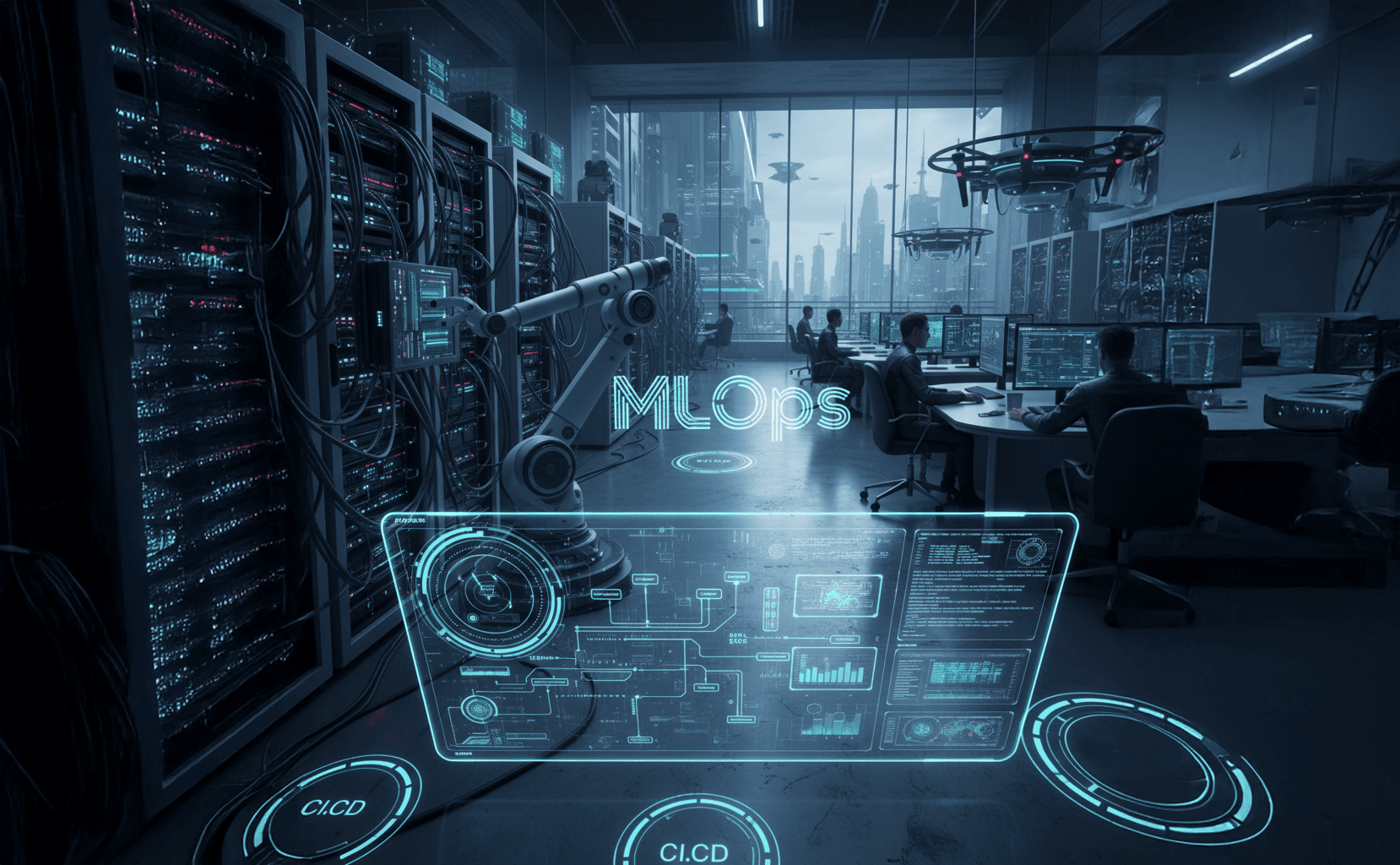
At its core, MLOps connects three critical layers:
Data pipelines – collecting, preparing, validating, and versioning the data used by models.
Model training and experimentation – tracking model versions, datasets, parameters, environments, and evaluation metrics.
Deployment and monitoring – releasing models into production, observing their technical and business performance, detecting drift, and triggering investigation, retraining, or rollback when required.
MLOps provides a continuous operating framework in which code, data, models, infrastructure, and governance controls can move consistently between data science, engineering, operations, and business teams.
The Operational Problems MLOps Solves
Without MLOps, data science can become a collection of experiments that are difficult to reproduce, deploy, and operate reliably.
Teams commonly struggle with:
Model versioning chaos – teams cannot reliably identify which model, dataset, code version, or configuration is running in production.
Reproducibility issues – experiments cannot be recreated because their data, parameters, dependencies, or execution environments were not recorded.
Deployment friction – handovers between data scientists, software engineers, and operations teams depend on manual processes and may take weeks.
Data and model drift – production data changes over time, potentially reducing model accuracy or changing its outputs without obvious technical failure.
Limited monitoring – infrastructure metrics may be available, while model quality, prediction patterns, bias, or business performance remain invisible.
Governance gaps – organizations lack consistent approval processes, audit records, ownership, and rollback procedures.
MLOps addresses these challenges through automation, lifecycle visibility, monitoring, and governance.

It ensures that models can be tracked, tested, approved, deployed, monitored, retrained, and rolled back with a level of control comparable to other production software.
At ASSIST Software, we have seen projects move from manual scripts and ad hoc model tracking to production systems with automated validation, deployment pipelines, model registries, monitoring, and controlled retraining workflows. That is the difference between an AI prototype and a production-ready AI solution.
The MLOps Pipeline in Action
An effective MLOps pipeline connects every stage of the AI lifecycle:
Data ingestion and validation – data is collected, cleaned, checked for quality, and tested for schema changes, missing values, invalid ranges, and unexpected categories.
Experiment tracking – model versions, datasets, parameters, environments, and evaluation metrics are recorded to reproduce results.
Model validation and registration – candidate models are evaluated against technical, business, and governance thresholds before approval and storage in a model registry.
Model packaging and CI/CD – containers, automated tests, and deployment pipelines help ensure that models are released consistently across environments.
Production monitoring and drift detection – monitoring identifies changes in data quality, input distributions, prediction patterns, model performance, latency, bias, or feature behavior.
Feedback, retraining, and rollback – workflows can trigger investigation, retraining, validation, or rollback when predefined thresholds are exceeded.
This continuous lifecycle allows organizations to update AI systems safely as new data becomes available, without treating every model release as a separate manual project.
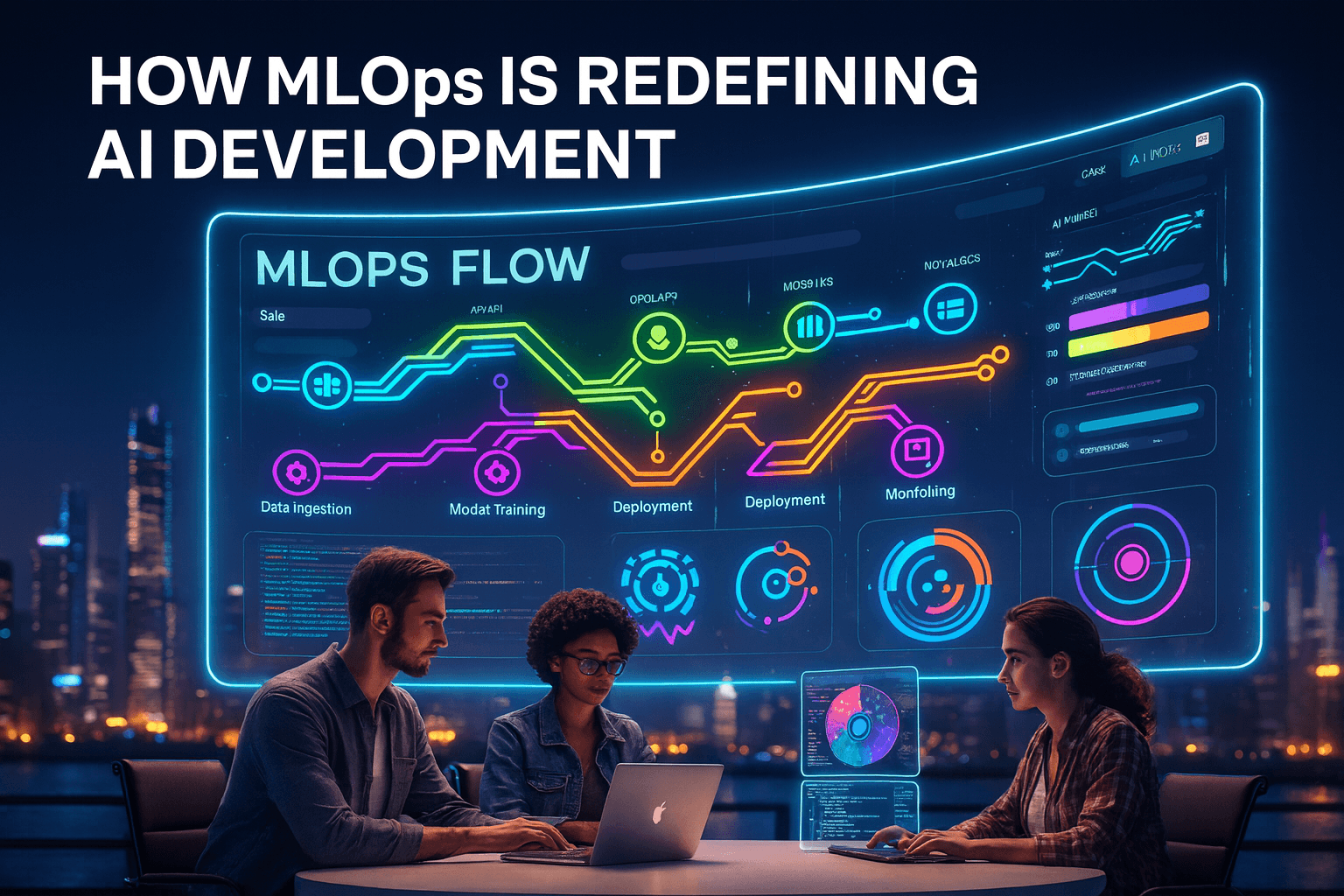
Key MLOps Tools and Trends in 2026
MLOps continues to mature as organizations move from isolated experiments to large-scale AI deployment.
Some of the commonly used platforms and tools include:
MLflow – experiment tracking, model packaging, lifecycle metadata, and model registry capabilities.
Kubeflow – Kubernetes-native orchestration for machine learning pipelines, training, and deployment.
DVC – version control for datasets, machine learning experiments, and pipeline dependencies.
Amazon SageMaker AI – a managed platform covering model development, registries, pipelines, deployment, monitoring, and governance.
Azure Machine Learning – a managed environment for experimentation, lifecycle management, deployment, monitoring, automation, and model operations.
Google Vertex AI – managed training, deployment, pipelines, model management, monitoring, and related AI infrastructure.
These solutions are not directly interchangeable. MLflow, Kubeflow, and DVC are often assembled into customized MLOps stacks, while the major cloud platforms provide broader managed environments.
Costs also differ significantly. Managed platforms generally use consumption-based pricing across compute, storage, training, inference, pipelines, and monitoring. Open-source tools may reduce software licensing costs but still require infrastructure, security, integrations, upgrades, and specialist engineering support.
Key trends in 2026 include:
- more unified data, model, deployment, and governance platforms;
- automated pipeline orchestration and policy-based approval gates;
- monitoring for generative AI applications and AI agents;
- stronger drift, bias, and model-quality observability;
- hybrid cloud and edge MLOps;
- greater attention to the operational cost of training, inference, and monitoring;
- increased demand for managed MLOps lifecycle services.
At ASSIST Software, our engineers work with managed cloud platforms and open-source technologies, alongside custom automation and integration layers, to create MLOps environments suited to each organization’s infrastructure, security requirements, and operational model.
MLOps and the New Culture of AI Engineering
Beyond tools and workflows, MLOps is driving a cultural transformation.
It bridges the gap between data scientists, who prioritize experimentation, and DevOps engineers, who prioritize stability and reliability.
In this new culture, collaboration replaces silos:
- Data scientists gain confidence in reproducibility and deployment.
- Engineers gain visibility into model behavior and performance.
- Business leaders gain faster delivery of AI that actually works in production.
MLOps transforms AI from a research effort into an engineering discipline, one that aligns with the reliability, scalability, and security standards of modern software development.

The Evolution of AI Starts with MLOps
The real breakthrough in enterprise AI does not come from building more capable models alone. It comes from creating the systems that allow those models to operate reliably after deployment.
That is what MLOps enables.
Organizations that adopt structured model lifecycle management are better positioned to move beyond prototype-stage AI, detect performance issues early, maintain auditability, and scale successful use cases across teams and environments.
The future of AI depends as much on operational excellence as it does on model innovation.
If you are ready to move from prototypes to production, ASSIST Software can help you assess your current architecture, select the right MLOps approach, and implement the pipelines, monitoring, and governance controls required to scale. Contact our team to discuss your MLOps strategy.
Contact ASSIST Software!
Frequently Asked Questions
What is MLOps and why does it matter? MLOps (Machine Learning Operations) is the discipline that bridges data science and software engineering. It applies automation, version control, and continuous delivery principles to machine learning systems, ensuring that AI models can be reliably built, deployed, monitored, and retrained at scale. Without MLOps, most AI projects stall at the prototype stage and never reach production.
What are the most common MLOps tools in 2026? The most widely adopted MLOps tools include MLflow for model tracking and lifecycle management, Kubeflow for scalable ML pipelines on Kubernetes, and DVC for dataset and experiment versioning. Cloud providers offer managed MLOps platforms — AWS SageMaker, Azure ML, and Google Vertex AI — which have become central to most enterprise AI infrastructure strategies.
- How do AI and data strategy companies use MLOps in practice? Organizations with mature AI and data strategies use MLOps to move from ad-hoc experimentation to repeatable, production-grade AI systems. This means automated retraining pipelines, continuous monitoring for model drift, and CI/CD workflows that allow models to be updated and rolled back with the same reliability as any other production software.