Small language models in enterprise AI: why the right model beats the biggest model in production
What small language models are and why the distinction matters
Four reasons enterprises are moving away from one-model-fits-all
The workflows where smaller models consistently outperform larger ones
Why the LLM versus SLM framing misses the point
How ASSIST Software approaches model selection in enterprise AI projects
The enterprises getting the most from AI are not using the biggest model everywhere
Frequently Asked Questions
Most enterprise AI budgets are still allocated as if the largest model were automatically the best choice for every workflow. That logic made sense during the experimentation phase, when the goal was to understand what AI could do. Today, as AI moves into production, cost, latency, data sovereignty, and deployment constraints are becoming as decisive as benchmark performance, and that is precisely where small language models are gaining ground.
The question driving enterprise AI strategy is shifting. It is no longer a question of which model is the most powerful. It is determining which model is the right one for the task, the infrastructure, the budget, and the risk profile. For a growing number of workflows, the answer is a small language model.
What small language models are and why the distinction matters
Small language models, or SLMs, are compact AI models with significantly fewer parameters than frontier large language models. They are generally less broad but more efficient, easier to deploy, and often capable enough for well-defined enterprise tasks. Examples include models from the Microsoft Phi family, Google Gemma, Mistral Small, smaller Qwen models, and compact Llama variants.
The meaningful distinction is not size alone. Large language models are built to be broad generalists, capable of reasoning across complex and varied contexts. Small language models are better suited to becoming specialists. A well-designed SLM can support internal knowledge search, classify documents, summarize support tickets, assist field engineers, analyze operational alerts, or answer questions based on company-specific procedures. For many enterprise workflows, that level of capability is exactly what is needed, and using a frontier LLM for every one of those tasks introduces unnecessary cost, latency, and governance complexity without delivering proportional value.

Four reasons enterprises are moving away from one-model-fits-all
- The first reason is cost. When AI moves from a pilot to a production system, usage volume changes dramatically. A pilot involves a handful of users testing a feature. A production system may handle thousands or millions of requests every month. At that scale, inference cost becomes a business decision with real impact on margins. Smaller models significantly reduce operational costs for repetitive, predictable, high-volume tasks, and those savings compound quickly at production scale.
- The second is latency. Many enterprise systems require fast responses. A cybersecurity analyst reviewing alerts, a factory operator checking equipment data, or a support agent handling a customer request cannot wait for a large cloud model to process every query. SLMs respond faster because they require fewer computational resources, and in time-sensitive workflows, that difference is not just a technical consideration. It affects operational performance.
- The third is data control. Organizations across healthcare, finance, manufacturing, defense, and critical infrastructure frequently handle sensitive information that cannot be routed through external cloud services due to certain compliance requirements. For these organizations, AI deployment is not only about what the model can do. It is about where it runs, who controls the data, and how the system aligns with internal governance and external regulatory requirements. Small language models are easier to deploy on-premises, in private cloud environments, or at the edge, making them significantly more practical for organizations with strict data sovereignty requirements.
- The fourth is specialization. Enterprises rarely need one model to handle every workflow. A smaller model fine-tuned on a narrow domain can outperform a larger general-purpose model for that specific task, because it has been tailored to the task rather than optimized for breadth. In practice, specialization often produces better results than raw capability for domain-specific enterprise applications.
The workflows where smaller models consistently outperform larger ones
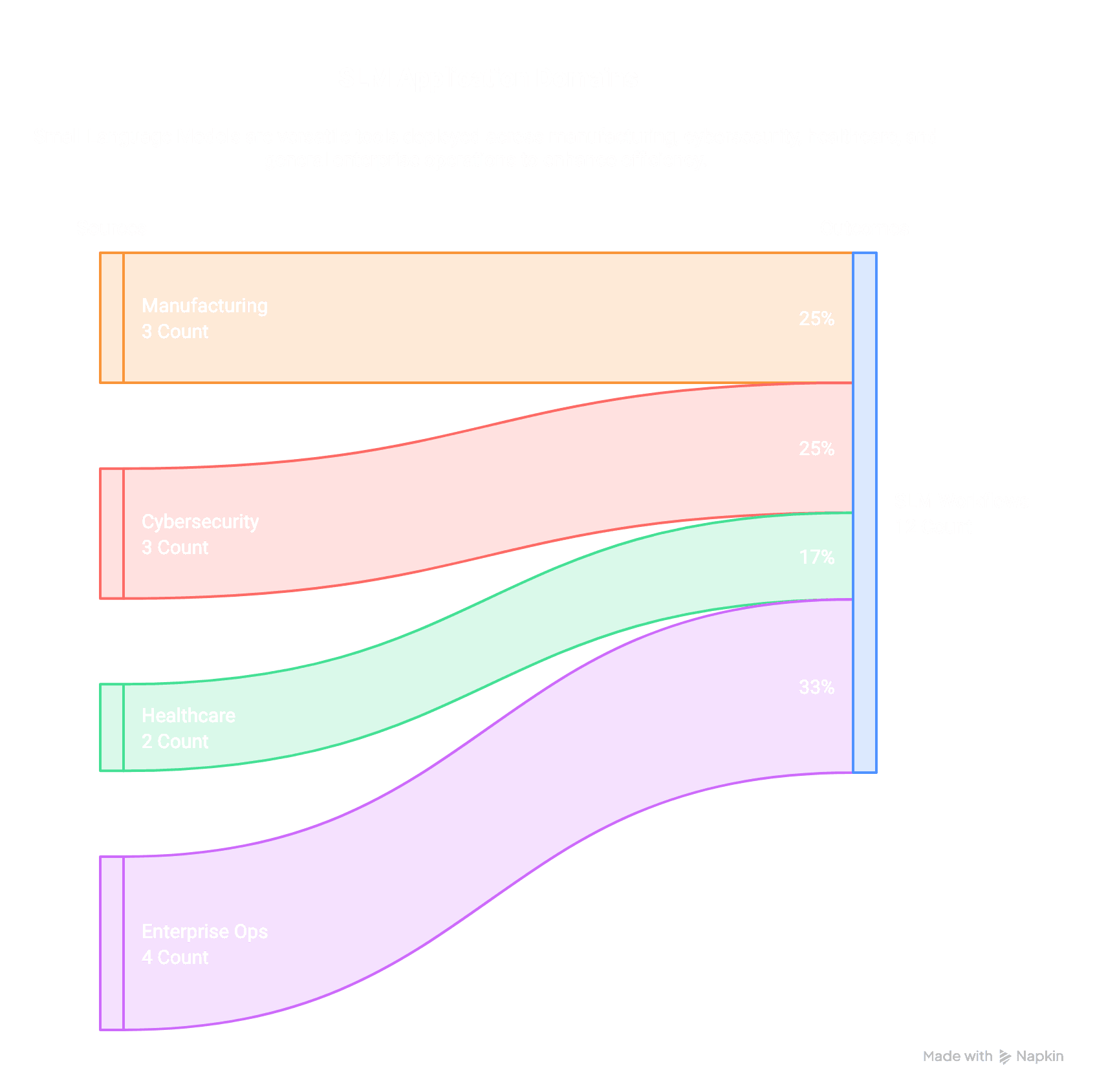
The pattern across industries is consistent. In manufacturing, SLMs support predictive maintenance workflows, assist technicians with equipment documentation, and help operators interpret machine alerts without the latency or cost overhead of a frontier model. In cybersecurity, they classify incidents, summarize known vulnerabilities, and retrieve internal response procedures quickly enough to support real-time analyst workflows. In healthcare, they support controlled documentation processes and assist staff with internal knowledge retrieval inside secure environments where data governance requirements limit the use of external cloud models.
In enterprise operations more broadly, SLMs power employee assistants, compliance support tools, document classification systems, and customer service workflows where the task is well-defined, the volume is high, and the need for broad reasoning is limited.
The deciding factor is usually the nature of the task. When a workflow requires broad reasoning, complex planning, or synthesis across multiple knowledge domains, a large language model is likely the better choice. When the task is narrow, frequent, latency-sensitive, cost-sensitive, or privacy-sensitive, a smaller model is often more effective and sustainable.
Why the LLM versus SLM framing misses the point
The enterprise AI conversation frequently positions large and small language models as competitors. That framing leads to the wrong decisions. The future of enterprise AI is not LLM versus SLM. It is an AI architecture, and the two model types serve different roles within it.
Most organizations will not rely on a single model for every workflow. They will build systems in which different models serve distinct purposes. A large model handles complex reasoning, planning, or strategic analysis. A smaller model handles document classification, internal search, workflow automation, or repetitive operational tasks. A retrieval-augmented generation framework pulls trusted enterprise data into the context. A governance layer monitors access, permissions, and compliance. Human oversight validates high-impact decisions before they are acted on.
In that architecture, the model is only one component. The value comes from orchestration: choosing the right model for each task, connecting it to the right data, controlling how it is used, and ensuring the system remains reliable as requirements evolve. Organizations that understand this build AI ecosystems that hold up over time. Those who optimize for a single model's capabilities often find that every market shift becomes an operational disruption.
How ASSIST Software approaches model selection in enterprise AI projects
At ASSIST Software, this shift is visible across the enterprise AI projects we work on. Organizations are seeking AI systems that integrate with existing platforms, protect sensitive information, comply with governance requirements, and scale without incurring unsustainable costs. The answer is rarely a single model. It is usually a considered combination of technologies: large and small language models, RAG frameworks, enterprise search, secure data pipelines, and domain-specific AI components working together toward a defined operational outcome.
ASSIST Software holds ISO/IEC 42001:2023 certification for Artificial Intelligence Management Systems, making it one of the first companies in Europe to achieve this standard. That governance discipline shapes how we approach model selection, integration, and lifecycle management across every AI initiative we take on. A model can perform impressively in isolation and still be the wrong choice for a specific business process. A smaller model can score lower on general benchmarks and deliver significantly more value in production. Getting that distinction right is where the real engineering work happens, and it is what determines whether an AI initiative creates lasting business value or requires rebuilding within two years.
The enterprises getting the most from AI are not using the biggest model everywhere
Small language models are gaining ground as enterprise AI matures. The early phase of generative AI adoption was defined by experimentation and fascination with capability. The next phase is being defined by deployment discipline, where cost, latency, data sovereignty, governance, and integration determine which AI investments hold up over time and which ones create more complexity than value.
Large language models will remain central to enterprise AI strategy. They will not be the only layer. The organizations best positioned to benefit from AI over the next several years are those building flexible, well-governed ecosystems where model selection follows business logic rather than hype cycles, and where the infrastructure supporting the model is treated as seriously as the model itself.

Frequently Asked Questions
- What is a small language model and how does it differ from a large language model?
A small language model is a compact AI model with significantly fewer parameters than frontier large language models. While large language models are designed as broad generalists capable of handling a wide range of tasks, small language models are more efficient, faster to deploy, and better suited to specific, well-defined workflows. The key distinction is the tradeoff between breadth and specialization: large models optimize for general capability, while small models optimize for efficiency and domain focus.
- When should enterprises use small language models instead of large language models?
Small language models are most effective when the task is narrow, repetitive, latency-sensitive, cost-sensitive, or involves data that cannot be processed by external cloud models under compliance requirements. Typical use cases include document classification, internal knowledge retrieval, operational alert analysis, and domain-specific workflow assistance. Large language models are better suited to tasks requiring broad reasoning, complex planning, or synthesis across multiple knowledge domains.
- What is AI model orchestration and why does it matter for enterprise AI deployments?
AI model orchestration refers to the design of systems where multiple models, data sources, and governance mechanisms work together to serve different parts of an enterprise workflow. Rather than relying on a single model for every task, orchestrated architectures assign the right model to the right task, combining large and small language models with retrieval-augmented generation frameworks, secure data pipelines, and human oversight processes. This approach improves cost efficiency, operational reliability, and governance across complex enterprise AI environments.